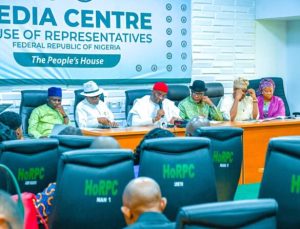
The House of Representatives has announced the official schedule for zonal public hearings across the six geopolitical zones of Nigeria, as part of efforts to amend the 1999 Constitution.
Speaking at a press briefing in Abuja on Tuesday, Deputy Speaker of the House and Chairman of the Constitution Review Committee, Rt. Hon. Benjamin Okezie Kalu, emphasized the importance of public involvement in the constitutional reform process.
“Our Constitution begins with the words ‘We the People of Nigeria,’ and it is only right that the amendment process reflects this principle,” Kalu stated. “We are decentralizing democracy and making it accessible to ensure that every Nigerian has a voice.”
According to the timetable, the hearings will take place in two phases. The northern hearings are scheduled from Friday, July 11 to Sunday, July 13, 2025, while the southern leg will run from Friday, July 18 to Sunday, July 20, 2025. A national public hearing will follow in Abuja on Monday, July 21, 2025.
Designated Zonal Centres
In the North Central zone, Minna will cater to residents of Niger, Kwara, and Kogi States, while Lafia will serve those in Nasarawa, Plateau, Benue, and the Federal Capital Territory. The North West zone will hold hearings in Kaduna (for Kaduna, Kano, Katsina, and Jigawa States) and Sokoto (for Sokoto, Zamfara, and Kebbi States).
For the North East, venues are Gombe (for Gombe, Bauchi, and Taraba States) and Maiduguri (for Borno, Yobe, and Adamawa States). In the South South, hearings will take place in Yenagoa (for Bayelsa, Edo, and Delta States) and Calabar (for Cross River, Rivers, and Akwa Ibom States).
The South East zone will use Enugu to accommodate Enugu, Ebonyi, and Anambra States, while Owerri will cover Abia and Imo States. For the South West, Lagos will host stakeholders from Lagos, Ogun, and Oyo States, with Akure covering Ondo, Osun, and Ekiti States.
To support informed participation, Kalu announced the publication of a simplified compendium of all constitution amendment bills under consideration. The document summarizes the key themes, titles, and highlights of the proposed changes and can be accessed at www.hccr.gov.ng.
“This publication is intended to simplify the process and make legislative content more accessible,” Kalu explained. “We want citizens to understand the issues, engage constructively, and contribute meaningfully.”
Among the critical areas up for review are judicial and electoral reforms, legislative effectiveness, power devolution, institutional reforms, fiscal federalism, gender equality, inclusive governance, local government autonomy, national security, recognition of traditional institutions, and the possible creation of new states and local councils.
Kalu noted that gender-related provisions have been carefully integrated into broader reform themes to ensure equality and inclusiveness.
He commended the media for its pivotal role in fostering civic awareness and accountability, noting that journalists were the first to receive the amendment compendium as a testament to their watchdog function in a democracy.
“We aren’t just inviting the media; we are involving them as stakeholders,” he said. “Transparency is incomplete without a vibrant and responsible press.”
The Deputy Speaker also disclosed plans to organize strategic dialogues with media executives and editors to deepen understanding and improve reportage of the review process.
Responding to concerns about the fate of past constitution review efforts, Kalu emphasized that constitutional reform is a continuous journey essential to any democratic society.
“Reform is not a one-time activity; it is a long-term investment in fairness, unity,
and national progress,” he asserted. “Past reviews have yielded important wins in areas like energy, transportation, and telecommunications devolution.”
He pointed out that some critical areas, such as state policing and increased women representation in governance, can only be achieved through constitutional amendments.
Kalu called on all Nigerians, including civil society groups, traditional rulers, youth and women organizations, religious institutions, and professionals, to engage fully in the process.
“This is not the time for apathy,” he warned. “If you fail to participate, you forfeit the right to complain. This Constitution belongs to all of us, it must reflect our collective hopes and dreams.”
He concluded by reiterating the House’s dedication to a fair, transparent, and inclusive constitutional review process, while responding to questions from journalists.