
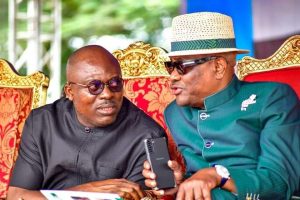
Fresh signs of a possible reconciliation between Rivers State Governor, Siminalayi Fubara, and his political mentor, now Minister of the Federal Capital Territory (FCT), Nyesom Wike, are beginning to surface following a high-level meeting in Port Harcourt.
The closed-door meeting, held on Saturday night, brought together Governor Fubara, Minister Wike, key members of the Rivers Elders and Leaders Council, leadership of the State House of Assembly, and several prominent pro-Wike politicians, including members of the National Assembly from Rivers State.
Sources indicate that the meeting was convened by Chief Ferdinand Alabraba, Chairman of the Rivers Elders and Leaders Council. However, concerns have been raised over the notable absence of Fubara’s loyalists, marking the second time a reconciliation effort appeared dominated by Wike’s camp.
This meeting follows Governor Fubara’s return to office on September 18, after the suspension of a six-month emergency administration during which Vice Admiral Ibok-Ete Ibas (retd.) served as State Administrator. Since his reinstatement, Fubara has reversed several appointments made during the interim period, including the dissolution of the State Pensions Board and the Microfinance Agency.
Who Was at the Meeting?
Attendees at Saturday’s meeting included:
- Political Leaders: Nyesom Wike, Governor Fubara, Chief Ferdinand Alabraba
- Rivers State House of Assembly: Speaker Martin Amaewhule, Deputy Speaker Dumle Maol, House Leader Major Jack
- National Assembly Members: Senator Barry Mpigi, Senators Magnus Abe, George Sekibo, Olaka Nwogu, Wilson Ake, Felix Nwaeke, and Kelechi Nwogu
- Legal and Political Figures: Onueze Okocha (SAN), Chief Sergent Awuse, Prof. Zacchaeus Adangor (SAN), Frank Owhor, Ken Chikere, Worgu Boms
- Others: Chief Victor Giadom (APC Deputy National Vice Chairman, South-South), Rivers PDP Chairman Chief Chukwuemeka Aaron, former Minister Udi Odum, and other prominent figures like Elder Chidi Wihioka, Dr. Chinyere Igwe, Chief Boma Iyaye, Chief Felix Obuah, and Dr. Fred Kpakol
While no official agenda was released, sources confirmed that the focus was on reconciling Wike’s loyalists with Governor Fubara and creating a framework for renewed cooperation.
Tensions Behind the Scenes
Despite the meeting, tensions remain. Some Fubara loyalists questioned the credibility of the reconciliation process, calling it one-sided.
Where are elders like Chief Rufus Ada-George, Dr. Gabriel Toby, or High Chief Anabs Sara-Igbe who stood by the governor? If this is reconciliation, it should be sincere and inclusive.
He compared the meeting to a previous instance during the emergency rule, when images of Wike, Amaewhule, and Fubara with President Bola Tinubu were circulated as signs of reconciliation, though lacking broad-based representation.
In contrast, a Wike loyalist defended the meeting, saying:
“Politics is about loyalty. What you’re seeing is the governor returning to his original political family. These are the same people who helped him become governor in 2023.”
Possible Next Steps
Sources suggest that Governor Fubara may soon forward a new list of commissioner-nominees to the Rivers State House of Assembly for screening—an indication that the political thaw may be producing tangible outcomes.
This development comes shortly after the governor sacked all commissioners and political appointees who were affected by a Supreme Court ruling affirming Martin Amaewhule as the legitimate Speaker of the State Assembly. That judgment also invalidated appointments made by the rival faction led by Victor Oko-Jumbo, a Fubara ally.
Calls for Peace and Inclusion
Meanwhile, the Rivers Peace Initiative, in a statement issued Sunday by its convener, Obinna Ebogidi, welcomed the renewed dialogue but called for patience, transparency, and broader inclusion.
Peacebuilding begins in stages. What matters is that dialogue has resumed. Leaders are meeting and showing courage to seek common ground, the statement said.
Ebogidi urged all political actors and citizens to avoid deepening the crisis:
No one wins in a divided Rivers State. We all benefit from a peaceful and stable environment where governance and development can flourish.