
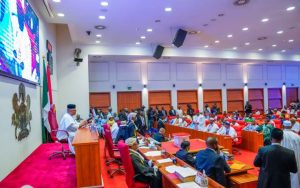
The House of Representatives on Wednesday passed for second reading a bill seeking to amend the Money Laundering (Prevention and Prohibition) Act, 2022, in a move aimed at strengthening Nigeria’s anti-corruption framework and improving asset recovery efforts.
The bill, sponsored by Hon. Yusuf Gagdi, who represents Kanke/Pankshin/Kanam Federal Constituency of Plateau State, seeks to modernise the country’s anti-graft laws in line with the evolving sophistication of financial crimes.
Nigeria’s anti-corruption framework has long faced challenges stemming from legal loopholes, weak enforcement, and political interference. Despite having multiple anti-graft laws, enforcement has remained inconsistent, allowing illicit financial flows—through trade misinvoicing, tax evasion, and resource theft—to cost the country billions annually.
Leading the debate, Gagdi described money laundering and illicit financial flows as “one of the most defining governance challenges of our time.” He explained that the amendment introduces a civil recovery mechanism that allows the government to reclaim assets linked to unexplained wealth through non-criminal proceedings, easing the evidential burden on law enforcement agencies.
Under the proposed law, individuals with suspicious assets would be required to prove the lawful origin of their wealth—an approach already effective in countries such as the UK, Kenya, and South Africa.
The bill also aims to empower agencies like the Economic and Financial Crimes Commission (EFCC) to apply for restraining orders on assets inconsistent with a person’s legitimate income and ensure transparent judicial processes.
Following deliberation, the bill received unanimous support and was passed for second reading through a voice vote conducted by Speaker Tajudeen Abbas. It has been referred to the relevant House Committee for public hearing and further legislative action.