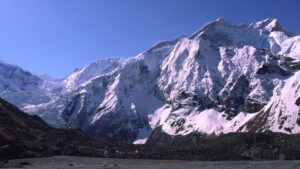
An Australian mountaineer has died during a descent from one of Nepal’s highest peaks, Himlung Himal, following severe weather and complications with rescue efforts.
Chin-Tark Chan, 49, reportedly fell ill during his climb of the 7,126-metre peak in the Annapurna range, according to expedition organiser 8K Expeditions. Although guides assisted him in descending, Chan collapsed at around 6,100 metres and could not be revived. Nepal’s Department of Tourism confirmed that efforts to recover his body are ongoing but have been severely hampered by heavy snow and poor weather conditions.
“He collapsed at an altitude of 6,100 metres,” said Himal Gautam, a spokesperson for the department. “Efforts are underway to retrieve the body.”
Lakpa Sherpa, Managing Director of 8K Expeditions, said the climber’s family and the Australian embassy in Kathmandu have been informed. The body is expected to be flown to the capital once weather permits.
Australia’s Department of Foreign Affairs and Trade (DFAT) confirmed it is providing consular assistance to Mr Chan’s family, offering condolences and liaising with both local and Australian authorities regarding funeral arrangements or repatriation.
According to Global Rescue, an emergency evacuation firm involved in the incident, they received a distress call from expedition owner Pemba Sherpa on October 27 reporting that Chan had become severely ill at 6,800 metres. He was reportedly disoriented, suffering symptoms of snow blindness, and later began vomiting blood and bleeding from the nose — signs of a rapidly worsening condition.
Rescue efforts were complicated by extreme weather and safety restrictions. Global Rescue advised guides to help Chan descend to Camp 3, the nearest safe landing zone, as helicopter extraction was deemed too dangerous at the time. However, expedition leaders launched an independent helicopter operation, which failed due to the worsening conditions. Chan was eventually brought down to Camp 3, where he suffered frostbite before succumbing to his illness on October 29 at around 6,500 metres.
The circumstances surrounding his death have since become a matter of dispute. Lakpa Sherpa accused Global Rescue of negligence, alleging that a delayed evacuation cost the climber his life. Global Rescue rejected these claims as “baseless and inconsistent,” maintaining that all actions were taken with safety as the top priority.
Despite ongoing snowfall and difficult terrain, Nepalese authorities say retrieval efforts are continuing.
Mr Chan’s death highlights the dangers of high-altitude climbing and the complex challenges of mountain rescues in the Himalayas, where sudden weather changes and thin air can turn emergencies into tragedies within hours.