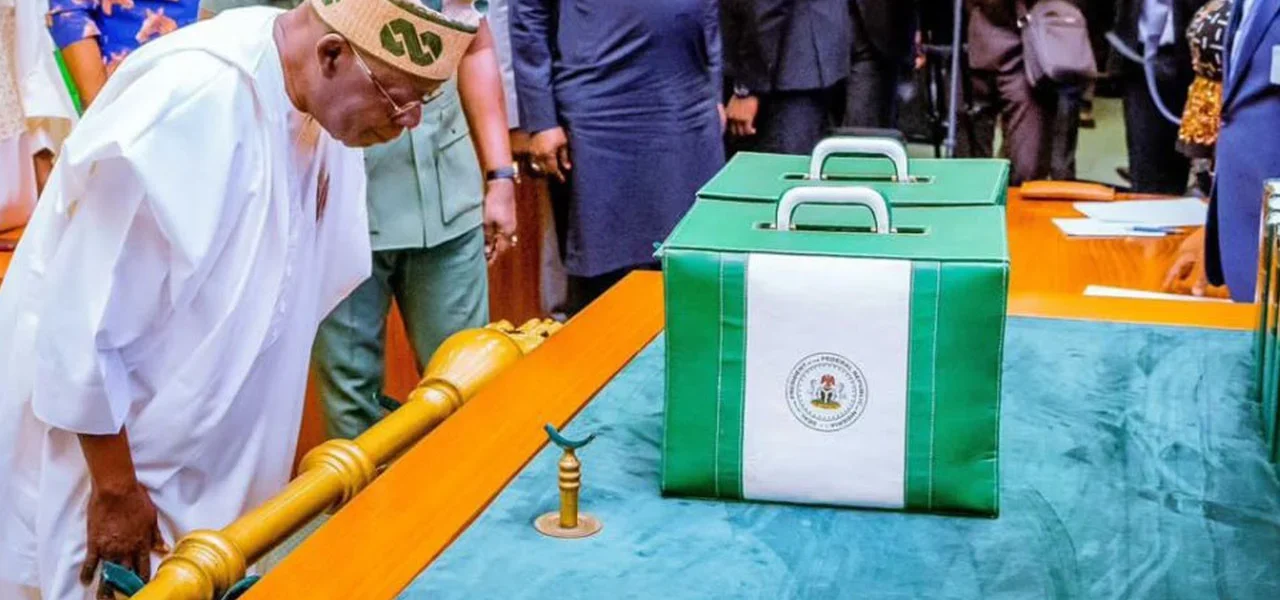
President Bola Tinubu has allocated N5.41 trillion to defence and security in the proposed 2026 budget, making it the single largest sectoral allocation.
This marks the third consecutive year that security spending has taken priority since the administration began presenting national budgets in November 2023. Tinubu disclosed this on Friday while presenting the N58.18 trillion 2026 Appropriation Bill to a joint session of the National Assembly.
The President said national security remains the bedrock of economic growth, investment and social stability. Under the proposal, defence and security spending of N5.41 trillion exceeds allocations to infrastructure, education and health, continuing a pattern seen in the 2024 and 2025 budgets amid ongoing threats from terrorism, banditry and kidnapping.
“Security remains the foundation of development,” Tinubu told lawmakers, noting that without peace and stability, other sectors cannot thrive.
Earlier in the day, the Federal Executive Council approved the 2026 budget framework at an emergency meeting chaired for the first time by Vice President Kashim Shettima. The council set total expenditure at N58.47 trillion, with rising costs driven largely by debt servicing, wages and security needs.
Tinubu said the security allocation would be used to modernise the armed forces, strengthen intelligence-led policing, improve border surveillance and support joint operations among security agencies. He stressed that spending would be tied to measurable outcomes.
“We will invest in security with clear accountability because security spending must deliver results,” he said.
The President also announced a major overhaul of Nigeria’s national security framework, including the introduction of a new counter-terrorism doctrine based on unified command, improved intelligence coordination and community stability.
Under the proposed policy, all armed groups operating outside state authority — including bandits, militias, kidnappers, armed gangs and violent cult groups — would be formally designated as terrorists, along with their financiers, informants and enablers. Tinubu said the move would close legal and operational loopholes that have allowed such groups to operate for years.
Beyond security, the budget proposes N3.56 trillion for infrastructure, N3.52 trillion for education and N2.48 trillion for health.
Acknowledging the strain on public finances, Tinubu insisted that prioritising security was unavoidable, linking it to broader development goals. He urged lawmakers to support the proposal, describing the budget as a step toward consolidating recent economic gains and restoring public confidence in the government’s ability to protect lives and property.