
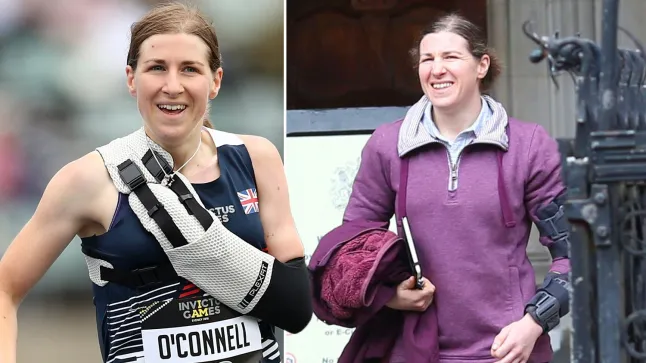
A former British soldier who went on to become a gold medal-winning para-athlete could face prison after being accused of lying about the extent of her disability in a multi-million-pound compensation case against the Ministry of Defence (MoD).
Debbie O’Connell, 37, suffered multiple fractures to her collarbone in 2015 after falling from a horse while training with the Royal Horse Artillery’s ceremonial unit, the King’s Troop. She later claimed the injury left her left arm almost unusable and forced her to leave the army two years later.
After her discharge, O’Connell built a successful para-sport career and won cycling gold medals at the Invictus Games in Sydney in 2018.
In September that year, she launched a £2.4 million damages claim against the MoD, later reduced to £1.74 million, alleging chronic pain and long-term disability. However, the claim was dismissed last year after a High Court judge ruled it was “fundamentally dishonest.”
Judge Christopher Kennedy KC said O’Connell’s evidence about ongoing pain “must be dishonest” after covert surveillance footage showed her using her injured arm for everyday tasks such as leading a horse and chopping vegetables. She was also ordered to pay more than £200,000 in legal costs.
The case returned to court last week after the MoD applied to have O’Connell committed to prison for contempt of court, arguing that she knowingly lied about the severity of her condition during the compensation proceedings.
Mr Justice Coppel allowed the contempt application to proceed, stating that it was in the public interest for such cases to move forward where claims had been prosecuted on a false basis.
During the original trial, O’Connell maintained that she suffered chronic pain in her left arm and shoulder, blaming the accident on ill-fitting riding boots and being assigned a horse known to buck. The MoD disputed her account, alleging she exaggerated her injuries while competing in the T46 para-athletics category, reserved for athletes with significant limb impairments.
MoD barrister Niazi Fetto KC said O’Connell had relied on a “dishonest pursuit” of a para-athletics career, despite her condition not meeting the criteria for that classification.
O’Connell denied any wrongdoing, telling the court she accurately described her condition during assessments and had been placed in her sporting category by officials. She said her military training taught her to push through pain and that she was doing her best to rebuild her life.
In his earlier judgment, Judge Kennedy noted that while O’Connell continued to report needing help with everyday tasks, the surveillance footage showed someone with “normal or near normal function” in her left upper limb.
He concluded that she had persisted with dishonesty over a long period and had made sophisticated attempts to conceal the truth.
At last week’s hearing, MoD lawyers argued that contempt proceedings, which carry a maximum sentence of two years’ imprisonment, were justified. O’Connell’s barrister, Ian Denham, countered that she had already suffered significant consequences and that findings of dishonesty had only been made to the civil standard of proof.
Mr Justice Coppel rejected that argument, clearing the way for the case to continue. A further hearing will now decide whether O’Connell is in contempt of court and whether she should face a prison sentence.