Iran launched a fresh wave of missile and drone attacks across several Gulf states on Sunday, March 8, targeting key infrastructure in Kuwait and Bahrain as the regional conflict entered its second week.
Authorities said Iranian strikes hit fuel storage tanks at Kuwait International Airport and damaged a desalination plant in Bahrain. Kuwait’s Interior Ministry also confirmed that two border guards were killed “while performing their national duty,” though further details about the incident were not disclosed.
Since the conflict began following large-scale strikes by the United States and Israel on Iranian targets, neighbouring Gulf states have experienced much of Tehran’s retaliation. According to an AFP tally, at least 16 people, including eight civilians, have been killed across the region so far. Iranian President Masoud Pezeshkian warned that Tehran would continue to respond if neighbouring countries allowed their territories to be used for attacks against Iran.
A day earlier, Pezeshkian had apologised to Gulf states hosting US military bases after Iranian strikes landed on their territory. Several countries reported new attacks over the weekend, including Saudi Arabia, the United Arab Emirates, Qatar and Kuwait, following explosions heard earlier in Dubai and Manama.
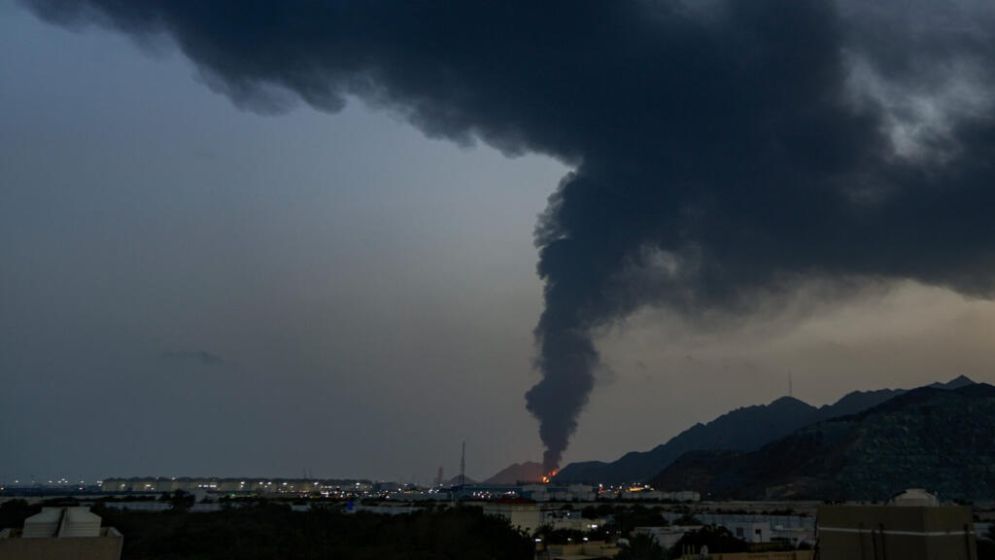
Kuwait’s military said a drone strike targeted fuel tanks at Kuwait International Airport. The Kuwait News Agency reported that the resulting fire was quickly contained and that no significant injuries were recorded.
The military described the attack as “a direct targeting of vital infrastructure.” Officials also said debris from interception operations caused damage to several civilian facilities.
Kuwait’s national oil company later announced a precautionary reduction in crude oil production as the country responded to multiple missile and drone threats. Authorities also reported that the country’s main social security building was struck, causing material damage and forcing it to close temporarily to visitors.
In Bahrain, the Interior Ministry said an Iranian drone strike damaged a water desalination facility and accused Tehran of indiscriminately targeting civilian infrastructure. Earlier, Iran’s Islamic Revolutionary Guard Corps claimed it had struck the United States’ Naval Support Activity Bahrain, alleging that the base had been used in attacks against an Iranian desalination facility.
Bahrain’s National Communication Office later stated that the strike on the water plant did not disrupt water supply or network capacity. Authorities also reported that falling missile debris injured three people and damaged a university building in the Muharraq area.
Saudi Arabia’s Defence Ministry said its air defence systems intercepted 33 drones launched toward the kingdom, including one targeting Riyadh’s diplomatic quarter and another aimed at the Shaybah oil field. Officials said no casualties or major damage were recorded.
The United Arab Emirates also reported that its air defence systems were responding to incoming missile and drone threats, while Qatar said that ten ballistic missiles and two cruise missiles fired from Iran the previous day were mostly intercepted.
Despite Iran’s earlier apology to neighbouring states, the country’s judiciary chief warned that attacks would continue on sites in Gulf countries that were “at the disposal of the enemy.” In response, UAE President Mohammed bin Zayed Al Nahyan said in a televised address that the country was now in “a period of war” but would ultimately emerge stronger.
In Dubai, authorities confirmed that a Pakistani national was killed after being struck by debris from an aerial interception. Dubai International Airport was briefly closed after an unidentified object was intercepted nearby.
Witnesses reported hearing a loud explosion followed by smoke rising near an airport concourse. Officials later described the incident as “a minor incident resulting from falling debris after an interception” and said no additional injuries were reported.