
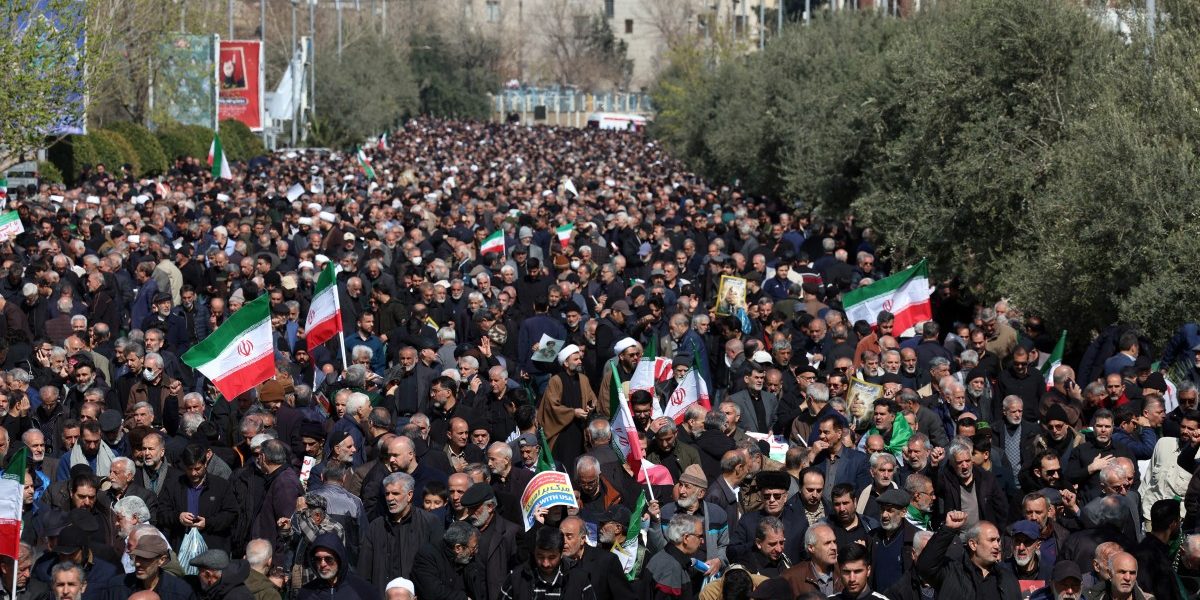
Iran has received a 15-point plan from the United States aimed at ending the ongoing Middle East war, Pakistani officials said Wednesday, raising hopes for a diplomatic solution even as Tehran fired cruise missiles at a US aircraft carrier.
The conflict, which began on February 28 with a US-Israeli bombing campaign on Iran, has rapidly spread across the region, driving up oil prices and threatening global economic stability.
US President Donald Trump has repeatedly claimed progress in talks with Iran, despite Tehran denying that formal negotiations are underway. Pakistani officials told AFP that the American proposals to halt the fighting were conveyed to Iran via Pakistani intermediaries, with Pakistan being seen as a potential mediator due to its ties with both nations.
Despite these diplomatic efforts, military operations continue across the region. Targets in Iran, Israel, Lebanon, Bahrain, Kuwait, Jordan, and Saudi Arabia have all been hit. Iran’s military said its cruise missiles fired at the USS Abraham Lincoln carrier group forced it to change course and warned of “powerful strikes” against any hostile fleet that comes within range. Meanwhile, Israel reported airstrikes on Tehran and a submarine development facility in Isfahan.
From Tehran, 40-year-old Shayan told AFP: “There is gasoline, water and electricity. But there is a sense of helplessness in all of us. We don’t know what to do, and there’s really nothing we can do.”
Hezbollah and Lebanon drawn into conflict
In Lebanon, Israeli warplanes struck the southern suburbs of Beirut, a stronghold of Iran-backed group Hezbollah. AFP correspondents reported damaged apartment buildings and streets littered with debris. Lebanon entered the conflict when Hezbollah fired rockets into Israel on March 2 in retaliation for the killing of Iran’s supreme leader, Ayatollah Ali Khamenei.
Lebanese authorities say over 1,000 people have been killed in more than three weeks of Israeli strikes, with over one million displaced. In the southern city of Tyre, Khalil, a resident in his 30s, expressed defiance: “They’ll have to take us by force… our heart is here.”
Behind-the-scenes diplomacy
Diplomacy appears to be progressing quietly. Regional sources told AFP that mediators are relaying messages between the sides, though optimism remains cautious. “There is hope but it’s too early to be optimistic,” said one anonymous source, noting that both sides need a way to de-escalate without losing face.
In public, Iran maintained a hardline stance. Mohammad Bagher Ghalibaf, speaker of Iran’s parliament, warned the US: “Do not test our resolve to defend our land.”
According to Israel’s Channel 12, Trump’s 15-point plan includes a ceasefire, a ban on uranium enrichment in Iran, and the reopening of the Strait of Hormuz, while Iran would receive sanctions relief. Similar proposals were offered by the Trump administration prior to a previous US-Israel bombing campaign in June.
Iran had previously agreed in 2015 to broad nuclear program restrictions, which Trump abandoned during his first term while intensifying pressure on the cleric-led state alongside Israel.
Economic impact and global response
The news of potential de-escalation led to rising stocks and falling oil prices, though concerns remain over the Strait of Hormuz, through which one-fifth of the world’s oil passes. Trump hinted at progress, saying Iran had given him “a very big present worth a tremendous amount of money,” referring to the Strait, which Iran had largely blockaded in retaliation for strikes.
Tehran assured the International Maritime Organisation (IMO) that non-hostile vessels would be allowed passage, but restricted ships belonging to the US and Israel.
Globally, energy markets and everyday life have already been affected. The International Energy Agency said it could release more reserves if needed. In Sri Lanka, authorities ordered an extra day off to conserve energy, while in Vietnam, diesel prices have doubled. Hanoi resident Nguyen Van Chi, a truck driver, told AFP: “With this unbelievable price of diesel, I cannot even sell my truck as no one is going to use it.”
The rewrite organizes the story into clear sections—diplomacy, military developments, regional impact, and economic fallout—making it more readable and easier for audiences to follow.
