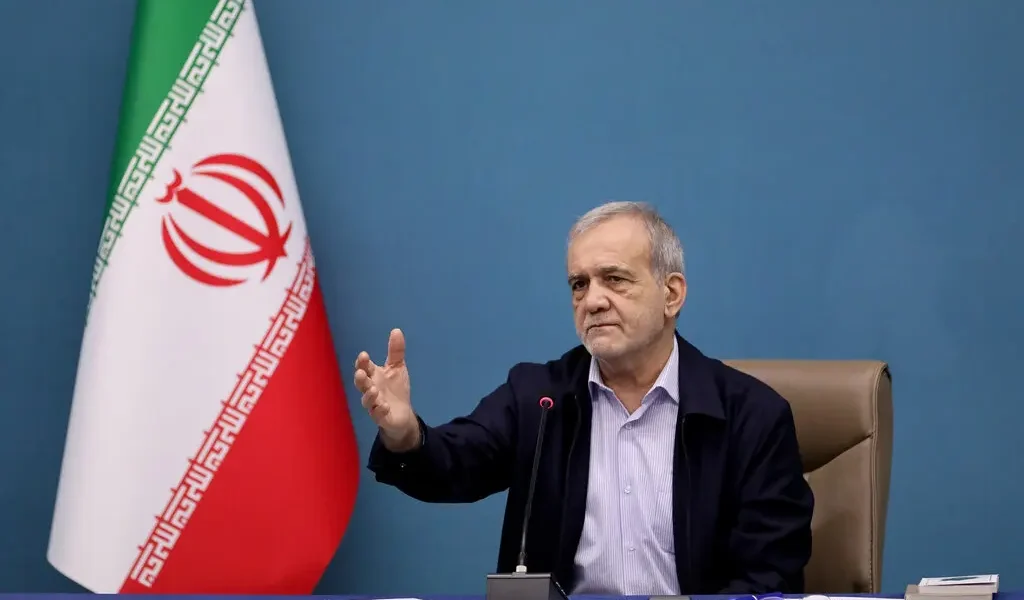
Iran’s President, Masoud Pezeshkian, has signaled a potential shift toward diplomacy in an open letter addressed to the American public, emphasizing that ongoing confrontation is becoming increasingly costly and ineffective.
In the message released Wednesday, Pezeshkian argued that conflict no longer serves the interests of those involved, stating that “the path of confrontation is more costly and futile than ever before.” He suggested that constructive engagement could help pave the way for a more stable future.
“Today, the world stands at a crossroads,” he wrote. “The choice between confrontation and engagement is both real and consequential; its outcome will shape the future for generations to come.”
The letter was published shortly before Donald Trump was expected to deliver a national address regarding the ongoing war. Earlier, Trump claimed Iran was seeking a ceasefire—an assertion Iran’s foreign ministry rejected as “false and baseless.”
While the overall tone of Pezeshkian’s message leaned toward diplomacy, it also underscored Iran’s longstanding stance on self-defense. He reiterated that Iran has not initiated conflicts but has consistently responded to external threats.
Despite the conciliatory language, the letter did not provide concrete proposals for ending the conflict, leaving uncertainty about whether it reflects a unified position within Iran’s leadership.
Under Iran’s political structure, ultimate authority rests with Supreme Leader Mojtaba Khamenei, who has final control over decisions related to war and negotiations. Meanwhile, the Islamic Revolutionary Guard Corps has expanded its influence during the conflict, with senior commanders playing a growing role in military strategy.
There has also been no official response from Tehran regarding a reported U.S. proposal for a 15-point peace plan. However, Trump indicated that senior American officials could participate in talks if negotiations progress.
In a recent phone call with António Costa, Pezeshkian stated that Iran would consider ending the war if certain conditions are met, including guarantees against future aggression.
The letter also addressed broader tensions between Iran and the United States, drawing a distinction between governments and citizens.
“The Iranian people harbor no enmity toward other nations, including the people of America, Europe or neighboring countries,” Pezeshkian wrote.
He maintained that Iran’s military actions are rooted in self-defense, adding that they should not be interpreted as acts of aggression.
“What Iran has done and continues to do is a measured response grounded in legitimate self-defense, and by no means an initiation of war or aggression.”