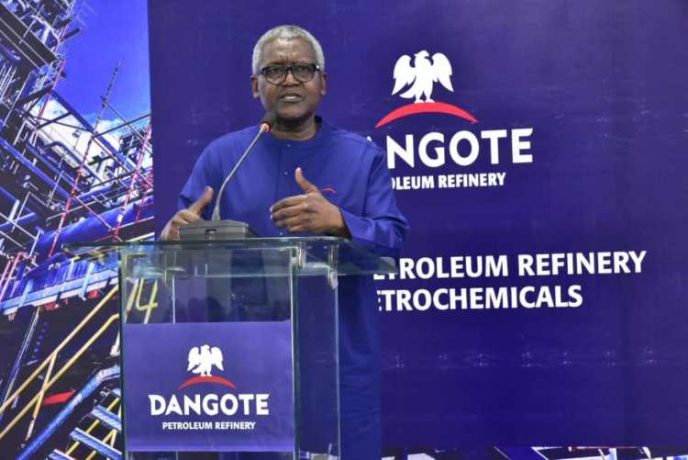
President of the Dangote Group, Aliko Dangote, has revealed that his company rejected attempts by the Nigerian National Petroleum Company Limited to increase its 7.25 per cent stake in the Dangote Petroleum Refinery.
Dangote made the disclosure during an interview with Nicolai Tangen, Chief Executive Officer of the Norwegian Sovereign Wealth Fund, monitored on Wednesday by one of our correspondents.
According to him, the decision was driven by plans to eventually list the refinery publicly and allow more Nigerians to own shares in the company.
“The national oil company already owns 7.25 per cent, and they are trying to buy more. We are the ones who said no because we want to spread ownership and allow everybody to participate,” Dangote said.
The NNPC had acquired the 7.25 per cent stake in 2021 for $1bn, with an option to increase its shareholding to 20 per cent by June 2024. However, the state oil company later chose not to proceed with the additional acquisition.
Dangote also identified policy inconsistency and potential civil unrest as major risks to business operations in Nigeria, though he noted that fears of civil conflict were currently not imminent.
Meanwhile, findings by The PUNCH showed that petrol supply from the Dangote Refinery rose sharply in the first quarter of 2026, with domestic supply reaching 3.18 billion litres, while imports declined significantly to 965.52 million litres.
The refinery, which is currently Nigeria’s largest and only major producer of petrol at commercial scale, supplied products estimated to be worth over ₦3.2tn during the period, based on an average ex-depot price of about ₦1,000 per litre.
The rise in local refining comes amid increased global demand for refined petroleum products following tensions between the United States and Iran, which disrupted global energy markets and boosted exports from the Dangote Refinery.
Data from the Nigerian Midstream and Downstream Petroleum Regulatory Authority showed that local refinery supply accounted for 76.7 per cent of Nigeria’s total petrol supply in the first quarter of 2026, while imports contributed 23.3 per cent.
Compared to the same period in 2025, local refining output rose by more than 59 per cent, while petrol imports dropped by over 60 per cent.
Dangote also disclosed that the refinery has exceeded its official production capacity of 650,000 barrels per day, saying the facility recently processed 661,000 barrels daily.
He said the successful operation of the refinery had strengthened investor confidence and positioned the group for future expansion.
Speaking on the impact of the Middle East crisis, Dangote said the company had benefited from rising global energy prices, noting that demand for products such as fertiliser, jet fuel, and polypropylene had surged significantly.
According to him, fertiliser prices rose from about $400 to $850 per tonne, while polypropylene increased from around $900 to nearly $3,000 in some markets.
“Our aviation fuel is sold out until the middle of July, and we are producing 20 million litres daily,” he said.
Dangote also disclosed that the refinery sources around 56 per cent of its crude oil from Nigeria, while the rest comes from countries including Angola, Libya, and the United States.
He further revealed plans to expand refining capacity to 1.4 million barrels per day within the next 30 months.
The billionaire businessman also accused certain vested interests of attempting to frustrate the refinery project because of profits previously made from fuel subsidies and imports.
According to him, the refinery has disrupted long-standing interests that benefited from Nigeria’s dependence on imported fuel.
Dangote added that the group plans to raise about $45bn through investments and partial sale of business stakes as part of a long-term target to achieve $100bn in annual revenue by 2030.