
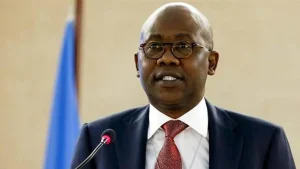
Former Attorney General of the Federation and Minister of Justice, Mohammed Adoke, has called on Nigerians to safeguard the country’s democracy from further decline, warning that the nation currently stands at a critical democratic crossroads.
Adoke made the remarks while delivering a paper titled “Safeguarding Nigeria’s Democratic Process: Issues and Prospects” during the 2026 Annual Law Week of the Nigerian Bar Association Abuja Branch in Abuja.
According to the former Attorney General, although Nigeria has sustained civilian rule since the return to democracy in 1999, public trust in the electoral system continues to weaken.
He noted that while the 1999 Constitution vested sovereignty in the people, recent developments within the country’s political space have raised concerns about the credibility and effectiveness of democratic institutions.
Adoke cited the 2023 general elections as an example, stating that the polls recorded widespread violence, low voter turnout and growing distrust in the electoral process.
According to him, the elections witnessed the loss of 89 lives and recorded a voter turnout of about 27 percent, which he described as the lowest since Nigeria’s return to democracy in 1999.
He also referenced reports by election observers and civil society organisations, which highlighted issues such as vote-buying, electoral violence and delays in the resolution of election petitions.
The former AGF argued that democracy should not merely be measured by the regular conduct of elections but by the confidence citizens have in the outcomes of those elections.
“Democracy does not collapse overnight; it erodes gradually when people lose faith in the process,” he warned.
Adoke stressed that Nigerians are not merely interested in democratic governance as a concept but desire a system that guarantees meaningful participation, free and fair elections, accountability and credible institutions.
He added that safeguarding democracy requires more than legal procedures, noting that it also demands integrity from political actors, courage from institutions and vigilance from citizens.
According to him, institutions must not only exist on paper but must also earn the trust of the people through transparency and adherence to constitutional principles.
The former minister identified several structural challenges confronting Nigeria’s democracy, including weak internal party democracy, manipulation of party primaries, financial barriers to political participation and declining public confidence in institutions.
He questioned whether Nigerians are genuinely participating in governance or merely observing the political process from the sidelines.
Adoke maintained that until democratic participation becomes more inclusive, transparent and credible, the constitutional promise of popular sovereignty would remain incomplete.
He further urged Nigerians to critically examine the country’s democratic structures and work collectively toward restoring credibility to the electoral process ahead of future elections, particularly the 2027 general polls.