
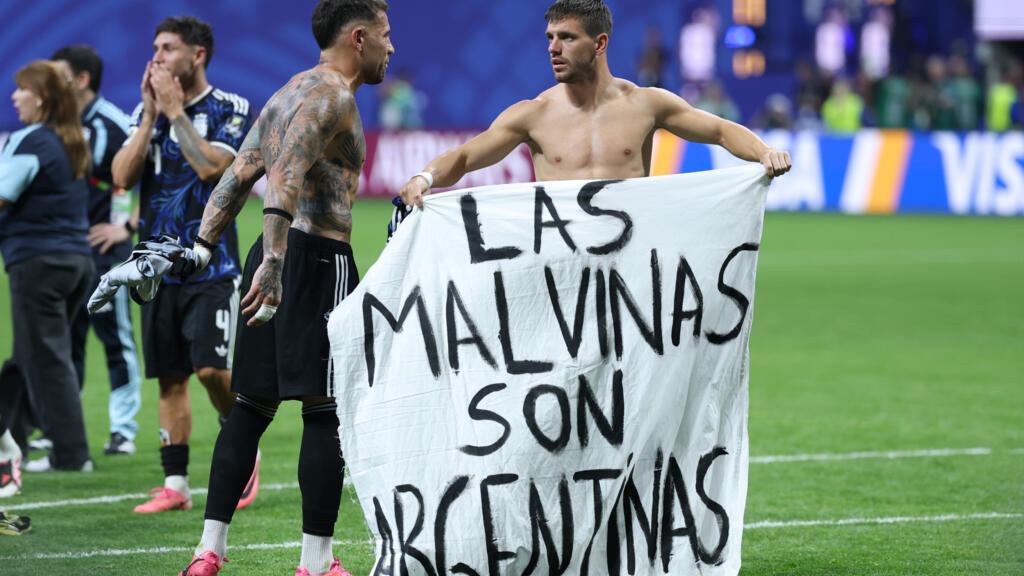
The British government has called on FIFA to investigate Argentina’s national football team after several players celebrated their World Cup semi-final victory over England with a banner asserting Argentina’s claim to the disputed Falkland Islands.
The controversy followed Argentina’s 2-1 win over England in Wednesday’s semi-final in Atlanta, where players posed with a banner handed to them by supporters that read, “Las Malvinas son Argentinas” (“The Malvinas are Argentine”). Argentina refers to the Falkland Islands as the Islas Malvinas.
UK Business Secretary Peter Kyle described the display as “entirely inappropriate” and urged world football’s governing body to launch a formal investigation, insisting that politics should have no place in football.
“I hope FIFA will carry out a proper inquiry,” Kyle told Times Radio.
Prime Minister Keir Starmer’s office also backed the call, reaffirming Britain’s position on the disputed territory.
“The World Cup might not be ours, but the Falkland Islands definitely are,” a Downing Street spokesperson said. “The right to self-determination belongs to the islanders, and our commitment to the Falkland Islands will never waver.”
Liberal Democrat leader Ed Davey also condemned the incident, arguing that players involved in displaying the banner should be barred from Sunday’s World Cup final.
The Falkland Islands, a British Overseas Territory located about 480 kilometres off Argentina’s coast, have remained at the centre of a sovereignty dispute between the two nations for decades. Britain maintains control of the islands, while Argentina continues to claim them as its own.
The dispute escalated into the 1982 Falklands War after Argentina’s military government invaded the islands. The 10-week conflict ended with a British victory and claimed the lives of 649 Argentine soldiers, 255 British military personnel and three islanders.
The political tensions surrounding the match had already been heightened before kick-off after Argentina’s Vice-President, Victoria Villarruel, referred to the British as “invaders.”
FIFA’s disciplinary code prohibits political, ideological, religious or offensive messages at football events. Violations can result in sanctions, including fines ranging from $5,000 to $20,000.
Among the Argentina players photographed with the banner were Lisandro Martínez, Alexis Mac Allister and Cristian Romero.
Martínez later defended the team’s actions, saying, “We couldn’t let the Argentine people down.”
Midfielder Leandro Paredes also addressed the controversy, describing the Falklands issue as a painful chapter in Argentina’s history.
“It is a sad part of our history for everyone involved. It hurts, and we knew we were playing for them too,” he said.
Kyle praised England’s players for avoiding political gestures, saying their conduct stood in “the perfect contrast” to Argentina’s celebrations.
“Politics needs to remain separate from football,” he told the BBC. “That principle is central to the World Cup, and this is now a matter for FIFA.”
As of Thursday, July 16, FIFA had not publicly commented on the incident.
The governing body has previously disciplined teams over political displays. In 2014, Argentina’s football federation was fined 30,000 Swiss francs after players displayed the same “Las Malvinas son Argentinas” slogan before the World Cup in Brazil.
FIFA also suspended South Korea’s Park Jong-woo for two World Cup qualifying matches after he displayed a political banner reading “Dokdo is our territory” at the 2012 London Olympics.
More recently, at the 2022 FIFA World Cup in Qatar, Serbia’s football federation was fined 20,000 Swiss francs after a political map depicting Kosovo as part of Serbia was displayed in the team’s dressing room.
The latest dispute comes just days before Sunday’s World Cup final between Argentina and Spain in East Rutherford, New Jersey, where FIFA President Gianni Infantino is expected to attend alongside US President Donald Trump and Argentine President Javier Milei.