
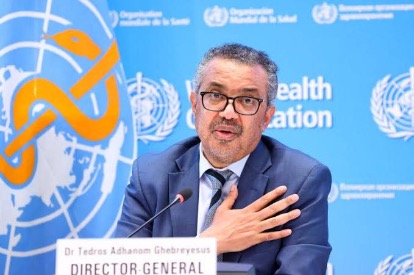
The World Health Organization (WHO) has warned that escalating conflicts, worsening food insecurity, disease outbreaks and declining humanitarian funding are pushing millions of people across the Eastern Mediterranean Region into a deepening health crisis.
In its latest Health Emergencies Situation Report, the UN health agency said fragile healthcare systems are under unprecedented pressure, leaving millions without access to essential medical services and life-saving assistance.
WHO identified Sudan as the region’s largest humanitarian emergency, revealing that 30.4 million people now require humanitarian assistance, while 13.5 million people have been displaced by the country’s ongoing conflict.
The organization warned that widespread disease outbreaks and severe funding shortages are threatening the collapse of critical healthcare services across Sudan.
WHO also expressed concern over renewed fighting in the Middle East, saying recent hostilities have reversed efforts to reduce tensions and significantly complicated humanitarian relief operations.
According to the report, fresh military strikes in Iran and parts of the Gulf, alongside attacks on commercial shipping and disruptions around the Strait of Hormuz, have disrupted medical supply chains and delayed the delivery of essential healthcare services.
Beyond the Middle East, WHO reported that more than 37.8 million people across the Greater Horn of Africa are facing acute food insecurity, with nearly 26 million people in Sudan, Somalia and Djibouti among the hardest hit.
To respond to the growing crisis, the agency is seeking US$6.42 million to support emergency health and nutrition programmes in Sudan, Somalia and Djibouti over the next six months.
The funding would help maintain primary healthcare services, nutrition programmes, disease surveillance, outbreak response, community outreach and the pre-positioning of essential medical supplies.
WHO said conditions continue to deteriorate in several conflict-affected areas, including the occupied Palestinian territory, Somalia, Yemen, Syria and Lebanon, where ongoing violence, displacement and climate-related disasters are placing enormous strain on already fragile health systems.
The agency noted that funding shortages have already forced the closure or reduction of services at more than 260 health facilities in Somalia, affecting around 1.62 million people. In Yemen, budget constraints have reduced access to healthcare for approximately 8.4 million people across 141 districts.
WHO’s 2026 Health Emergencies Appeal for the Eastern Mediterranean Region requires US$633 million, but nearly 40 per cent of the required funding has yet to be secured, putting emergency response operations at risk.
The report also highlighted the growing danger faced by healthcare workers and facilities. In June alone, WHO verified 27 attacks on healthcare facilities, resulting in 10 deaths and 75 injuries. Lebanon recorded the highest number of incidents, followed by the occupied Palestinian territory and Sudan.
Between January and June 2026, WHO documented 369 attacks on healthcare facilities across the Eastern Mediterranean Region, accounting for nearly half of all verified attacks on healthcare worldwide during that period.
