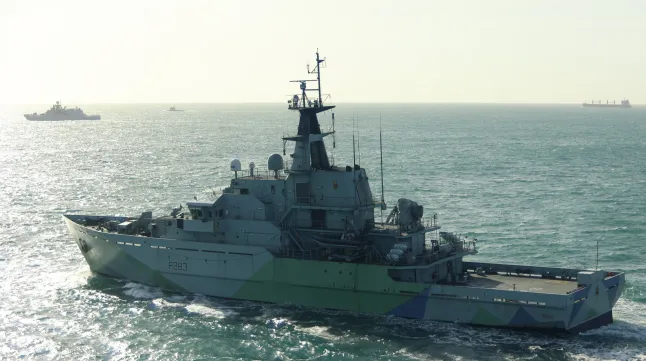
A Russian warship conducted a live-fire artillery exercise about 46 miles off the coast of Plymouth on Monday, July 20, prompting the Royal Navy to closely monitor its activities.
The UK Ministry of Defence said the Russian frigate Neustrashimy informed HMS Tyne, a Royal Navy offshore patrol vessel, of its intention to carry out the exercise before firing its weapons. A French military aircraft also contacted the warship by radio to seek clarification about the operation.
According to the BBC, HMS Tyne was instructed to move to a safer distance while the exercise was conducted. The live-fire drill lasted approximately 30 minutes, with the Ministry of Defence saying it continues to monitor the Russian vessel’s movements.
The incident is the latest in a series of encounters involving Russian naval vessels near UK waters. Russian warships regularly pass through international waters in the English Channel but are not permitted to enter British or French territorial waters.
Last month, Royal Marines boarded a Russian-linked “shadow fleet” oil tanker in the Channel during a six-hour operation, marking the first mission of its kind carried out by UK forces.
In June, a retired British couple sailing a 40-foot yacht near the Isle of Wight was involved in a separate incident with the Russian frigate Admiral Grigorovich. Moscow accused the couple of making a dangerous approach, while the couple denied being on a collision course with the warship.
The couple claimed the frigate sounded its horn before firing warning shots into the air, an incident former Prime Minister Sir Keir Starmer described as “reckless.” The Russian Navy, however, said it had attempted to contact the yacht through radio messages, flares and sound signals.
The Admiral Grigorovich had also been monitored continuously by Royal Navy patrol vessels for a month earlier this year while escorting Russian ships through the North Sea, the Western Approaches and other international waters.
Late last year, the Russian corvette RFN Stoikiy was intercepted by HMS Severn while passing through the Dover Strait before being handed over to a NATO ally near the French coast. Another Russian vessel, Yantar, which has been linked to the mapping of undersea cables, was also detected operating near UK waters during the same period.