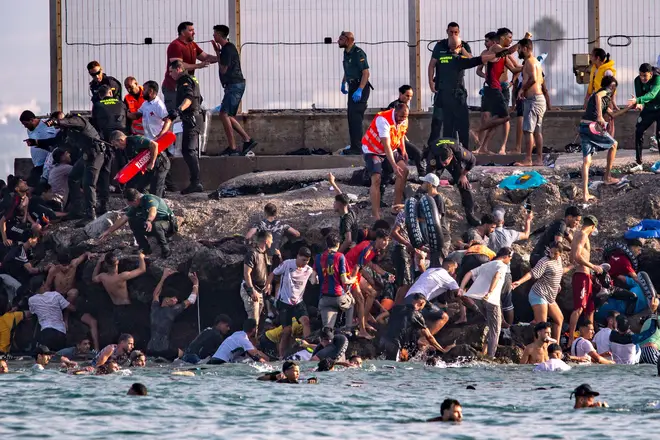
Spanish authorities have reported that nearly 49,000 migrants entered the North African enclave of Ceuta from neighbouring Morocco in a single day, in what could become one of the largest mass border crossings in Spain’s history.
The unprecedented movement occurred on Thursday, July 31, as thousands of migrants, mostly young Moroccan men, reportedly swam around a breakwater from Morocco to reach a beach in Ceuta. The surge overwhelmed Spanish police, prompting the deployment of the army to help manage the situation.
The number of arrivals was almost five times higher than the daily peak recorded during the 2015 European migration crisis, when hundreds of thousands of refugees entered Europe, mainly from Syria and Afghanistan.
Spain’s National Security Department, which operates under the office of the prime minister, stated in an online post on Friday morning that “more than 49,000” people had entered Ceuta. The statement was later removed. It also said security forces had recovered the bodies of 19 people from the waters.
The migrants included women, children and people from countries other than Morocco. On Friday morning, further attempts were made by some migrants to scale border fences, leading to clashes with Spanish police.
Meanwhile, thousands of those who had entered Ceuta began returning to Morocco after being informed they would not be allowed to remain in Spanish territory, according to Spain’s national news agency EFE.
The Spanish government said it had reached an agreement with Morocco to “strengthen coordination and review measures to enable the return, as soon as possible, of people who have entered Ceuta irregularly.”
Madrid blamed the crisis on people-smuggling networks, accusing them of exploiting a recent Supreme Court ruling that prevents authorities from intercepting and immediately returning migrants who arrive by sea in Ceuta and Melilla.
Ceuta and Melilla, two Spanish territories located on Africa’s northern coast, remain key entry points for migrants attempting to reach the European Union.