
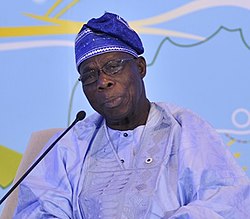
Former President Olusegun Obasanjo has described his decision to choose former Vice President Atiku Abubakar as his running mate in the 1999 presidential election as the biggest mistake of his time in office.
Obasanjo made the remark on Friday during a fireside chat with veteran entertainer and activist Charles Oputa, popularly known as Charly Boy, at the launch of Charly Boy’s foundation and memoir, 999: A Memoir in Tribute to Late Justice Chukwudifu Oputa, in Lagos.
Reflecting on his years as president, Obasanjo said that while every leader makes mistakes, selecting Atiku as his deputy was the one decision he regretted most.
A video of the event, later shared by iWitnessLive TV on YouTube, captured the former president responding after Charly Boy asked him to identify the greatest mistake of his administration.
“What I have found in my own life is that mistakes that could have been fatal, God had taken care of them for me,” Obasanjo said.
When asked to mention one specific mistake, he replied:
“The man I picked as my running mate, my number two. If I had known him as I came to know him later, I would not have picked him.”
When Charly Boy sought clarification on whether he was referring to Atiku, Obasanjo responded:
“My vice president. I don’t know what name you want to give him, but my vice president, I mean that.”
He added that, with the benefit of hindsight, he would have made a different decision.
“Of course, what I know about him later… I would not have picked him. Thank God that God did not allow his actions and reactions to overwhelm me, divert my focus from Nigeria or harm Nigeria,” he said.
Despite his criticism, Obasanjo said he bears no personal grudge against his former deputy.
“There’s no bitterness because he did what he believed he should do, and God did what God had to do, which enabled me to achieve what I was able to achieve,” he added.
The comments are among Obasanjo’s strongest public remarks about his former vice president and revive a political rivalry that has shaped Nigeria’s democratic politics for more than two decades.
Obasanjo and Atiku were elected as Nigeria’s first civilian President and Vice President after the end of military rule in 1999 on the platform of the Peoples Democratic Party (PDP). During their first term, they were widely regarded as a formidable political team, with Atiku playing a key role in the National Economic Council, the National Council on Privatisation, and several economic reform programmes.
However, their relationship deteriorated during Obasanjo’s second term, particularly after Atiku opposed efforts by allies of the president to amend the Constitution to allow a third presidential term.
The collapse of the controversial third-term agenda in 2006 deepened the rift between the two leaders and sparked one of the fiercest political battles of Nigeria’s Fourth Republic.
The dispute later escalated into a legal battle after Obasanjo declared Atiku’s office vacant following his defection from the PDP to the then Action Congress ahead of the 2007 general election.
The Supreme Court eventually ruled that the president had no constitutional power to remove an elected vice president, allowing Atiku to complete his tenure.
Since leaving office, the two political heavyweights have repeatedly exchanged accusations of corruption, political betrayal and abuse of office.
In his 2014 memoir, My Watch, Obasanjo accused Atiku of corruption, disloyalty and placing personal ambition above national interest. Atiku rejected the allegations, accusing his former boss of attempting to rewrite history and portraying himself as a victim of political persecution during the final years of the administration.
Although they briefly reconciled ahead of the 2019 presidential election, when Obasanjo endorsed Atiku’s presidential bid against former President Muhammadu Buhari, the alliance was short-lived, and both men later resumed their political differences.
In recent years, Obasanjo has consistently urged Nigerians to prioritise competence, integrity and national interest when choosing the country’s leaders.