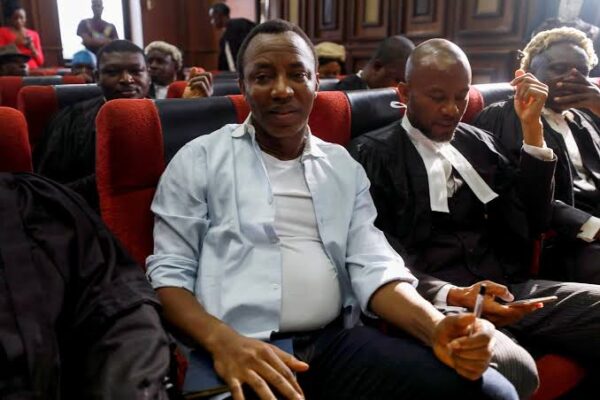
Tension erupted at the Federal High Court in Abuja on Monday during the continuation of Omoyele Sowore’s criminal trial, as his counsel, Adeyinka Olumide-Fusika (SAN), clashed with prosecuting lawyer Akinlolu Kehinde (SAN), whom he accused of acting like a “persecutor” rather than a prosecutor.
The heated exchange followed an application by the defence for another adjournment, citing delays by the court registry in releasing a Certified True Copy (CTC) of documents it described as essential to presenting its case.
Fusika told Justice Muhammed Umar that the defence had been informed that a Department of State Services (DSS) witness was present in court following a subpoena issued to the agency’s Director-General, Oluwatosin Ajayi, but the team was unable to proceed without the certified documents.
He explained that the defence applied for the CTC on July 22, 2026, but was repeatedly told by the registry that the request had not been approved by the judge. The defence later discovered that Justice Umar had approved the application on July 27.
“Obviously, the fault is not from Your Lordship’s end. It is a registry issue. The document is prefatory to the continuation of the defence,” Fusika told the court.
Opposing the adjournment request, Kehinde accused the defence of deliberately delaying proceedings and prolonging the case on the court’s docket.
He argued that both parties had previously agreed that a DSS officer would appear as a defence witness and that the prosecution had fulfilled its part of the arrangement by ensuring the witness was available.
“That part of the agreement was kept by the prosecution,” Kehinde said, adding that the witness was expected to testify regarding Exhibit DWD.
The prosecution counsel argued that the defence, having applied for the documents, had a responsibility to follow up with the registry before the hearing date. He urged the court to close the defence’s case, insisting that several opportunities had already been granted.
Kehinde maintained that granting further delays was a matter of judicial discretion and that the constitutional right to fair hearing did not include an unlimited opportunity to stall proceedings.
Responding, Fusika accused the prosecution of ignoring the facts presented before the court and shifting blame to the defence over issues outside its control.
He insisted that the defence had not engaged in delaying tactics, noting that it could have insisted on calling the DSS Director-General if it intended to frustrate the trial.
The senior advocate argued that the defence could not dictate when the judge would approve its application and had to rely on information provided by the registry.
Citing Sections 4 to 13 of the Evidence Act, Fusika said the requested documents were relevant to the defence’s planned line of questioning. He also described the allegation that the defence was intentionally delaying the case as “insulting,” given the resources involved in attending court proceedings.
Justice Umar noted that since the prosecution closed its case, the defence had produced only one witness and that the matter had been adjourned about four times at the defence’s request.
In response, Fusika provided a timeline of events from June 22, 2026, when he took over the conduct of the case, to show that the defence had acted diligently.
The proceedings became heated when Kehinde attempted to make further submissions and Fusika interrupted, accusing him of behaving like a “persecutor” rather than a prosecutor.
Justice Umar immediately cautioned the senior lawyer, warning that any further outburst could result in a referral to the appropriate disciplinary authorities.
The judge later adjourned the matter until September 20, 2026, for continuation of the defence after ruling that proceedings could not continue at that stage.
At the previous sitting, the defence withdrew its subpoena compelling the DSS Director-General to testify after the prosecution argued that the evidence expected from the witness had already been admitted twice during the trial.
The Federal Government is prosecuting Sowore on a two-count charge of cyberbullying over allegations that he described President Bola Tinubu as a “criminal” in posts on his official X and Facebook accounts. Sowore has pleaded not guilty to the charges.