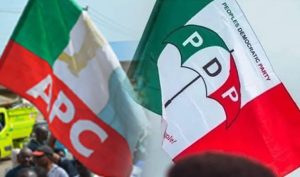
Nigeria’s political history has repeatedly demonstrated that no political party remains in power indefinitely. Parties rise when they enjoy public confidence and begin to lose ground when internal divisions, poor leadership and growing public dissatisfaction weaken their connection with voters.
The Peoples Democratic Party (PDP) provides one of the clearest examples. After governing Nigeria continuously from 1999 to 2015, the party lost power following years of internal disagreements, defections, leadership challenges and declining public confidence.
Now, with the All Progressives Congress (APC) approaching 12 years in power by 2027, political observers are drawing comparisons between the challenges that contributed to the PDP’s defeat and some of the controversies currently confronting the ruling party.
Among the issues attracting attention are allegations of political godfatherism, weak internal democracy, perceived high-handedness, favoritism and the prioritisation of personal interests over collective party objectives.
While the political circumstances surrounding the APC are different from those of the PDP, analysts argue that the similarities should serve as a warning to the ruling party ahead of the 2027 general elections.
One area generating controversy is the conduct of recent APC primary elections. Some aspirants who reportedly emerged victorious in the primaries have alleged that their names were later substituted with those of other candidates who did not participate in the contests.
One of those affected is Prof. Kohol Shadrach Iornem, who said he won the APC primary for the Kwande/Ushongo Federal Constituency in Benue State before his name was allegedly replaced by Hon. Terseer Ugbor.
Iornem said the primary election was conducted in the presence of officials of the Independent National Electoral Commission (INEC) and that the results were submitted as required.
According to him, the affected candidates were later informed through media reports that their names had been substituted without prior consultation.
He argued that the Electoral Act provides specific circumstances under which a candidate can be replaced, including voluntary withdrawal, death or the conduct of another primary election.
“First, the law provides that a candidate may voluntarily withdraw by signing the appropriate withdrawal form. Second, the candidate may die, but I’m very much alive. The other option is that another primary election must be conducted before a candidate can be replaced,” he said.
Iornem also questioned the petitions allegedly used as the basis for the substitutions, saying the affected aspirants were neither shown the petitions nor given an opportunity to respond to the allegations against them.
He described the situation as a breach of fair hearing and called for greater transparency in the party’s internal processes.
The former aspirant also expressed concern over reports that INEC had rejected the list containing the substituted candidates, stressing that his primary concern was not personal advantage but adherence to due process.
According to him, candidates who were freely chosen by party members should not be removed without following the provisions of the law.
He appealed to the APC leadership to convene a dialogue involving all affected parties, warning that failure to address the grievances could deepen divisions within the party ahead of the 2027 elections.
Iornem said party supporters who participated in the primary elections expected their votes to be respected and argued that replacing their preferred candidates without proper justification could further weaken confidence in the party.
The controversy has renewed wider debates about internal democracy within political parties in Nigeria.
Political observers have noted that one of the factors that contributed to the PDP’s decline was the growing influence of political godfathers and powerful interests in determining party candidates and leadership positions.
Critics argue that when influential individuals dominate party structures, popular support and competence can become secondary to political connections.
The APC came to power in 2015 on a promise to provide an alternative to the politics associated with the PDP. However, critics now accuse the ruling party of displaying similar tendencies in some states, including alleged imposition of candidates, controversial primaries and excessive influence by powerful political figures.
Analysts warn that such practices could weaken party unity by alienating members who believe they have been denied a fair opportunity to participate in the political process.
Another issue is the perception of intolerance toward dissenting voices.
Political parties require internal debate, consultation and compromise to remain healthy. When disagreements are treated as acts of disloyalty, analysts say, internal tensions can quickly develop into larger political crises.
Some APC members and observers have accused the party of becoming increasingly intolerant of opposing views, with political exclusion, disciplinary actions and public disagreements occasionally dominating political discussions.
However, the extent to which these concerns will affect the party’s electoral prospects remains uncertain.
Another major issue is public perception of governance and the management of public resources.
Before the PDP lost power in 2015, concerns over corruption, alleged misuse of public resources and poor governance contributed to growing dissatisfaction among voters.
The APC itself gained significant support by campaigning on promises of transparency, accountability and a stronger fight against corruption.
Today, opposition parties and civil society groups continue to raise questions about government spending, accountability and the management of public resources.
Whether individual allegations are ultimately proven or not, political analysts argue that public perception remains crucial in determining electoral outcomes.
For the APC, the lesson from the PDP is therefore clear: political dominance does not guarantee permanent control of government.
The PDP once expressed confidence that it could remain in power for decades, yet it eventually lost the presidency after 16 years.
As the 2027 elections approach, the APC faces the challenge of managing internal disagreements, strengthening its democratic structures and maintaining the confidence of its members and the wider electorate.
Political power, analysts note, is ultimately sustained by public trust. If the ruling party fails to address legitimate grievances and adapt to changing expectations, the same forces that once brought the PDP down could eventually threaten the APC.
The coming months will therefore be crucial in determining whether the APC can learn from Nigeria’s political history or risk repeating the mistakes that ended the PDP’s long reign.