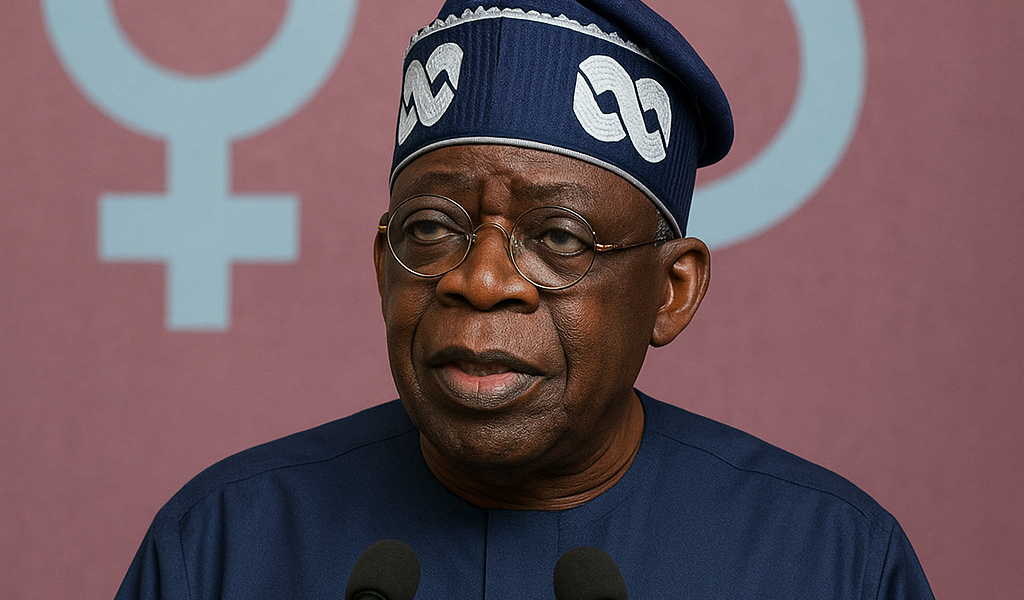
President Bola Tinubu has given four reasons why records concerning him held by the United States Federal Bureau of Investigation (FBI) and Drug Enforcement Administration (DEA) should not be released publicly.
In court filings submitted by his lawyers and published on Saturday, Tinubu argued that the US Freedom of Information Act (FOIA) and Privacy Act restrict the disclosure of the records, while insisting that there was no recognised public interest strong enough to justify their release.
The President also argued that the request was motivated by political considerations and that the plaintiff had an ulterior motive for seeking government documents containing his name.
The legal team representing Tinubu comprises Christopher Carmichael, Victor Henderson and Oluwole Afolabi.
The submission was made in response to a lawsuit by American transparency activist Aaron Greenspan, who is seeking the release of Tinubu-related records under the US Freedom of Information Act.
The development has attracted criticism from opposition parties in Nigeria, which argue that Nigerians have a right to know about the President’s past.
Background to the controversy
Questions surrounding Tinubu’s history with US law-enforcement agencies became a major issue ahead of the February 25, 2023 presidential election after documents relating to a 1993 US civil forfeiture proceeding emerged.
A US District Court in Illinois ordered the forfeiture of $460,000 held in an account linked to Tinubu after US authorities alleged that the funds represented proceeds from narcotics trafficking or were connected to prohibited financial transactions.
The APC maintained during the presidential election petition proceedings that the case was a civil forfeiture proceeding and did not amount to a criminal conviction.
The Labour Party and its then-presidential candidate, Peter Obi, argued that the forfeiture amounted to a conviction that should disqualify Tinubu under the Nigerian Constitution.
However, the Presidential Election Petition Court ruled in September 2023 that the petitioners had failed to establish that Tinubu had been arrested, arraigned, convicted or sentenced in a criminal case in the US.
Since then, opposition groups and other interested parties have continued efforts to obtain official information about Tinubu from US authorities.
Why Tinubu is opposing disclosure
Greenspan argued that his request concerned the “sitting President of Nigeria” and “a nation of over 230 million people whose daily lives are directly affected by President Tinubu’s decisions.”
However, Tinubu’s lawyers urged the US District Court to reject the request, arguing that it amounted to an attempt to obtain private information for political purposes in Nigeria.
The legal team argued that the purpose of the FOIA was to provide access to information about government activities and rejected the suggestion that Nigerians’ interest in Tinubu’s background constituted a public interest recognised under US law.
They also dismissed the argument that the records were relevant to Tinubu’s fitness for office.
“The asserted ‘public interest in Tinubu’s own fitness for office’ is not an interest FOIA recognises or one that needs to be balanced,” the lawyers argued.
They further maintained that the records sought were protected by privacy provisions under the FOIA and the US Privacy Act.
“The redacted information sought by the plaintiff is exempt from disclosure,” they stated, citing Exemption 7(C), which protects personal information contained in law-enforcement records.
Tinubu’s lawyers also relied on a 1989 US Supreme Court ruling, Department of Justice v. Reporters Committee for Freedom of the Press, which they said established that FOIA was intended to enable the public to know “what the government is up to,” rather than provide access to information about private citizens.
According to the legal team, Greenspan was seeking “disclosure of information about private citizens that is accumulated in various governmental files,” which “reveals little or nothing about an agency’s own conduct.”
Lawyers allege political motive
Tinubu’s legal team also challenged what it described as the political motivation behind Greenspan’s request.
The lawyers argued that Greenspan’s court filings demonstrated that his main objective was to obtain documents containing Tinubu’s name.
“All of plaintiff’s other critiques should be viewed in the context of plaintiff’s overarching goal,” they stated.
They added that Greenspan’s filings “overwhelmingly demonstrate that his singular focus is obtaining documents with intervenor’s ‘name on them.’”
The President’s lawyers urged the court not to allow the FOIA process to become a means of obtaining private information simply because the individual concerned holds political office.
They also rejected claims that the records could reveal a secret prosecution or an agreement by US authorities not to prosecute Tinubu, describing such assertions as speculative and unsupported by evidence.
“Unsubstantiated allegations are easy to assert in filings, but insufficient to justify a request for information about an individual,” the lawyers said.
They argued that Greenspan had failed to provide evidence establishing that any alleged government wrongdoing had occurred, as required under US case law.
“Plaintiff has not carried his burden to obtain law enforcement records that mention or identify a private individual,” they stated.
Tinubu seeks continued withholding of records
Tinubu’s lawyers also disputed the argument that his privacy interests had been extinguished because some information relating to the historical investigation had previously become public.
Greenspan had argued that the general nature of the investigation had been in the public domain since 1993.
However, Tinubu’s legal team said the 1993 forfeiture proceedings, including an affidavit filed in the case, did not disclose details or the outcome of any possible criminal investigation involving the President.
The lawyers maintained that even where some information had appeared in public records, an individual could still retain a privacy interest in details that had not previously been disclosed.
They therefore asked the court to deny Greenspan’s motion for summary judgment and allow the FBI and DEA to maintain their redactions and withholding of the records.
Among the documents sought are the “entire FBI file” on Tinubu and FBI Form 302 interview records involving him between 1992 and 1993.
In April 2025, US District Judge Beryl Howell ordered the FBI and DEA to lift their “Glomar” responses, under which the agencies had declined to confirm or deny whether responsive records existed. She also directed the agencies to process the requested records subject to applicable exemptions.
The FBI has since sought to withhold portions of the records, citing exemptions covering law-enforcement information, personal privacy, investigative techniques and the safety of individuals.
The ongoing FOIA case concerns access to US government records. It does not, in itself, constitute a criminal prosecution or establish that Tinubu committed a drug-trafficking offence.
Opposition demands release of records
The African Democratic Congress (ADC) and Nigeria Democratic Congress (NDC) have criticised Tinubu’s opposition to the release of the records, saying Nigerians deserve to know the truth.
ADC spokesperson Bolaji Abdullahi described the President’s position as suspicious and urged him to allow the records to be made public.
“Why is the President opposing the release of his past records? That is suspicious. The President should allow them (records) to be released to clear himself. The President should come out clean. He should be the one calling for the records to be released if he has nothing to hide because this is not good for him and the image of the country,” Abdullahi said.
Similarly, NDC National Publicity Secretary Osa Director said the argument that the records were being sought for political purposes was not sufficient justification to prevent their release.
He said Nigerians deserved to know the truth and urged Tinubu to allow the records to be made public.
“When a man commits an offence and he says, please, don’t blame me because it is the devil, does that mean he should not face the consequence of his action because it is the devil? That is the question the President should answer.
“Whether it is the opposition or not, if the issue wasn’t there, the opposition would not capitalise on it. Why did the opposition not ask the FBI to release records on our presidential candidate, Peter Obi, or Atiku? That is not an excuse.
“Nigerians deserve to know and in the interest of the President. He deserves to clear the air. This case has been hanging on since his time as a governor. It is over 20 years. Even me, as an opposition, am getting bored. It is time, once and for all, that he should clear the air to allow the issue to be buried,” Director said.