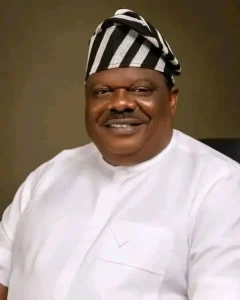
The Peoples Democratic Party (PDP) governorship candidate in Benue State, Chief Michael Kaase Aondoakaa (SAN), has endorsed the establishment of state police, describing it as a necessary response to Nigeria’s growing security challenges.
Aondoakaa, a former Attorney-General of the Federation and Minister of Justice, said the idea of state police was first proposed during the 2009 constitutional reform process under the late President Umaru Musa Yar’Adua but failed to secure approval at the time.
According to him, the proposal was driven by the need to address the enormous challenges confronting the Nigeria Police Force in effectively policing the country.
“State police is an idea that in 2009, during the first constitutional reforms which we did under President Yar’Adua, we introduced because of the enormous challenges facing the federal police in policing the country,” he said.
The former minister acknowledged that the establishment of state police could present challenges but maintained that, if properly structured and implemented, it could significantly strengthen security across the country.
He commended President Bola Ahmed Tinubu for advancing the initiative but stressed the importance of putting adequate safeguards in place to prevent state governors and politicians from abusing the system.
Aondoakaa identified recruitment, arms procurement and oversight as areas requiring particularly strong regulation.
He warned against allowing politicians to influence the recruitment of personnel, insisting that only qualified and credible individuals should be admitted into the state police.
“The issue of recruitment must be handled in a manner that politicians are not allowed to come in and bring people who are not worthy to be police officers,” he said.
He also opposed a situation where individual states would independently procure firearms and other security equipment from the international or local open market.
“There should be a level of control. It will be a lot of confusion if the entire 36 states go to the market and import arms for their state police,” Aondoakaa cautioned.
He consequently proposed a centralised regulatory framework for the procurement of arms and other security equipment, suggesting that the Office of the National Security Adviser could play a role in coordinating the process.
The PDP candidate further called for stronger judicial oversight at the local level, particularly through magistrates who may be required to interact closely with state police operations.
He argued that such judicial officers must have sufficient independence to effectively perform their oversight responsibilities.
Aondoakaa Advocates Private Sector-Led Ranching
On the issue of ranching and livestock production, Aondoakaa advocated a private sector-driven model, arguing that government should concentrate on creating an enabling environment rather than directly owning and operating ranches.
According to him, livestock production is fundamentally a private business and should be treated in the same manner as other agricultural value chains.
He warned that government-owned ranches established to serve private cattle owners could create confusion and deepen suspicion among farmers and communities.
“Livestock owners are private businessmen engaging in farming activities of livestock. There will be a disconnect and there will be confusion because the ranches are established by government and then they are to service private sector holders of cattle,” he said.
Aondoakaa proposed that the government should instead develop the necessary infrastructure, policies and financing framework to encourage private investors to establish and operate ranches.
“My understanding is that ranching should be done in the way the rice and wheat value chain was created. Government should create the environment and allow private investors to drive the business,” he stated.
He also advocated the crossbreeding of existing cattle breeds to improve milk production and make livestock farming more commercially viable.
“First, let us crossbreed the cattle that we have now so that they can give sufficient milk for commercial trading. Then allow them to borrow at interest rates below five percent and approach ranching as a private sector business,” Aondoakaa said.
He cautioned that turning livestock production into a predominantly public-sector programme could generate further resistance among farmers and other stakeholders.
“If we now decide to say let us take one aspect of farming and make it a public sector issue, then there will be more agitation by the farmers across the country,” he warned.