
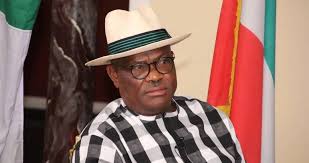
The Minister of the Federal Capital Territory, Nyesom Wike, has denied allegations that he rigged the 2023 presidential election in the South-South region in favour of President Bola Tinubu against Labour Party candidate Peter Obi.
Wike made the clarification while addressing journalists in Abuja on Wednesday, describing the allegation as a “baseless narrative propagated primarily on social media.”
The controversy followed comments Wike made during an interview on TVC’s Journalists’ Hangout, where he said the G5 governors had strategically allowed Obi to win in parts of the South-South during the 2023 presidential election.
His remarks drew criticism from opposition figures, commentators and other political actors, who interpreted them as an admission of electoral manipulation.
Wike, however, said his comments referred to a political strategy adopted by the G5 governors to weaken Atiku Abubakar, the presidential candidate of the Peoples Democratic Party (PDP), rather than an attempt to manipulate election results.
Responding to allegations that he personally altered result sheets to favour Tinubu, Wike questioned how one person could determine the outcome of an election conducted across thousands of polling units.
“People who don’t understand, how can they say I rigged the election? How would I have done it? So, I just took the result sheets, wrote it, and gave it to INEC?” he asked.
The FCT minister also dismissed the reliance on social media projections, noting that the country had about 176,000 polling units.
“I’ve always said social media does not win elections. You have about 176,000 polling units, and probably you have seen 300 polling units and then you rush to the conclusion that so-and-so has won.
“Election outcomes are not predicted this way,” he said.
Wike further argued that opposition parties failed to substantiate their allegations of electoral manipulation in court.
“You remember that when they went to the tribunal, did anybody tender any result from Rivers to say, ‘look, this is the result, we won’?” he asked.
Explaining the strategy adopted in the South-South, traditionally regarded as a PDP stronghold, Wike said Atiku was considered the major political threat to the G5 coalition.
According to him, the strategy was to channel votes towards Obi in certain areas to reduce Atiku’s support and prevent him from securing a dominant margin in the region.
“We felt that Atiku was more of a factor in that election than Obi. So our strategy was that, make sure that you vote for Obi to win in order to deny Atiku the votes.
“South-South was purely a PDP state and so if we had voted for PDP all through, then Atiku would have won. That was a threat,” Wike said.
He also played down Obi’s growing national support at the time, arguing that the G5’s calculations were based on electoral numbers rather than social media activity.
“Obi wasn’t a threat. Obi was merely a threat by social media. Even if Obi had secured Rivers outright, it would not have altered the outcome of the presidential race.
“Assuming Obi won Rivers, add it for him. Would he have won the election?” he asked.
Wike maintained that manipulating an election in an area where a candidate lacked grassroots support would be difficult because voters could resist such an attempt.
“When you talk about rigging, you cannot rig an election where you are not popular. You cannot. If you try that, then you see what will happen to you. People will resist it,” he said.
The minister urged Nigerians and political analysts to focus on verified electoral data and the mechanics of elections rather than conclusions drawn from social media.
“We had our strategy, and that strategy worked well for us.
“Our major opponent was Atiku Abubakar and if we didn’t do that, something would have happened,” he said.