
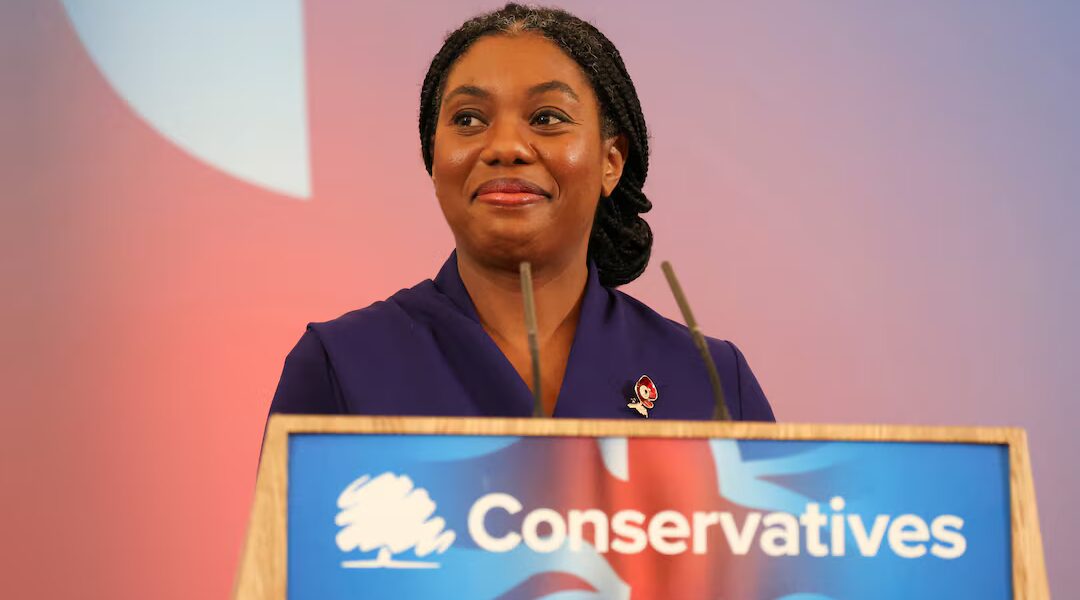
British Conservative Party leader Kemi Badenoch has strongly condemned what she described as racist attacks against her after a former adviser to Nigel Farage repeatedly referred to her as a “Nigerian scammer” on social media.
Badenoch, who has Nigerian heritage, insisted that attempts to use her racial background against her for political advantage would not succeed.
The controversy began after Raheem Kassam, a former UKIP adviser, published several social media posts attacking the Conservative leader and making references to her Nigerian background.
In one post, Kassam reportedly accused Badenoch of using her Nigerian heritage to advance her political career whenever it suited her.
In another, he suggested that people should avoid sharing their credit card or bank account information with her.
The comments sparked criticism and renewed debate about racism and personal attacks in British politics.
Speaking during an interview on ITV’s Good Morning Britain, Badenoch accused some figures associated with Reform UK of focusing on her identity rather than presenting policies that could improve people’s lives.
“I think it just shows the sort of people they are,” she said.
Badenoch argued that her political opponents were spending too much time attacking her personally instead of addressing the challenges facing ordinary British citizens.
“They’re not talking about how they’re going to make people’s lives better. They’re spending most of their time attacking me. You’d think that I was the prime minister,” she said.
She suggested that some of her critics believed bringing her race into political arguments could help them gain support.
“I think they think that maybe using my race is a way for them to improve their standing,” she added.
However, Badenoch maintained that such tactics would ultimately fail.
“Britain is not a racist country and because it’s not a racist country, their racist attacks and using my race as an attack form is not going to work,” she declared.
Robert Jenrick refuses to describe comments as racist
The controversy intensified after Robert Jenrick, a former Conservative MP who defected to Reform UK, declined to condemn Kassam’s remarks as racist.
Speaking to ITV, Jenrick acknowledged that the comments could be considered unpleasant or rude but stopped short of describing them as racially discriminatory.
“I don’t think they were… were they unpleasant or were they rude? Maybe, but it’s not my place to police everybody’s tweets who may or may not be a supporter of Reform,” he said.
When asked about Jenrick’s position, Badenoch dismissed the former Conservative politician as no longer being her responsibility.
“He’s not one of my MPs. He’s not my problem anymore. He’s Nigel Farage’s problem,” she responded.
Jenrick also used the opportunity to question Badenoch’s previous account of receiving an offer to study at Stanford University in the United States.
He accused her of making inaccurate claims about a pre-medical scholarship.
Badenoch has maintained that she received an offer from Stanford when she was 16, although she acknowledged that she no longer possesses documents relating to it.
The claim has previously been questioned in media reports.
Nigel Farage responds to controversy
Reform UK leader Nigel Farage was also questioned about Kassam’s comments during an appearance on BBC Breakfast.
Farage argued that referring to someone’s Nigerian upbringing was not automatically racist.
“I don’t think saying somebody grew up in Nigeria is racist,” he said.
However, when pressed further, he acknowledged that the remarks had gone too far while maintaining that he did not believe they were deliberately racist.
“Do I think the comment was over the top? Yes, I do. Do I think it was intentionally racist? No, I don’t,” Farage stated.
The disagreement has added to tensions between the Conservative Party and Reform UK as both parties compete for political support.
Labour condemns Jenrick’s response
The Labour Party also criticised Jenrick for refusing to describe the remarks against Badenoch as racist.
A Labour spokesperson argued that condemning racism should not depend on political affiliation.
“He can’t even call out blatant racism against his former party leader. Calling out racism isn’t a matter of party politics. It’s about basic decency,” the spokesperson said.
The latest dispute follows another controversy involving former Conservative politician Suella Braverman, who joined Reform UK, over remarks interpreted by critics as questioning whether people from minority ethnic backgrounds could identify as English.
During her party conference speech earlier this month, Badenoch accused Reform of encouraging divisive debates about national identity.
She specifically criticised what she described as attempts to question whether her mixed-race children should be regarded as English.
Despite the controversy, Badenoch has maintained that Britain is not fundamentally a racist country and that attacks targeting her background will not prevent her from continuing her political work.
The row has reignited discussions about racial identity, political campaigning and the boundaries of acceptable criticism in British public life.

