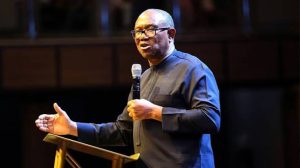
The Deputy Spokesperson of the Nigeria Democratic Congress (NDC) National Campaign Council, Dr. Sam Omale, has declared that state governors will have little influence on the outcome of the 2027 presidential election, insisting that voters, rather than political office holders, will determine the next president.
Omale also expressed confidence that the party’s presidential candidate, Mr. Peter Obi, would secure overwhelming support in the South-East and South-South regions, as well as record another impressive performance in the Federal Capital Territory (FCT).
In an interview with Joy Anigbogu, the NDC chieftain argued that the growing number of governors defecting to the All Progressives Congress (APC) would not necessarily translate into electoral victory for the ruling party.
He maintained that Nigerians were more concerned about their economic difficulties, insecurity and rising cost of living than the political affiliations of their governors.
According to him, the people are increasingly dissatisfied with the current administration and are seeking leadership that can address their challenges.
Omale said the political dynamics ahead of the 2027 elections would be driven by voters’ experiences and expectations rather than the influence of governors.
He argued that governors had only their individual votes and could not automatically determine the choices of millions of residents in their respective states.
On the South-East, where some governors have reportedly expressed support for the APC, Omale insisted that the people remained largely sympathetic to Obi’s political ambition.
He described the support for the former Anambra State governor as a reflection of his perceived integrity, leadership capacity and commitment to improving the lives of Nigerians, rather than ethnic or religious considerations.
The NDC spokesperson said Obi was not seeking votes because he was Igbo or Christian but on the strength of his character, competence, integrity and willingness to tackle corruption and economic hardship.
He further described the South-East and South-South as strongholds for the NDC candidate, predicting that the APC would struggle to secure significant votes in the South-East.
Omale also dismissed suggestions that Obi had lost the political appeal and credibility he enjoyed during the 2023 presidential election following his movement across political parties.
He insisted that the former governor remained consistent in his political vision and policy objectives, arguing that the country’s worsening economic situation had made the need for alternative leadership even more compelling.
Addressing concerns about Obi’s position on fuel subsidy removal, Omale argued that the candidate’s approach was centred on tackling corruption and eliminating the alleged financial leakages associated with the subsidy regime.
He maintained that corruption was at the heart of the subsidy controversy, alleging that public funds had been lost through payments for products that were not actually supplied.
On the criticism surrounding Obi’s movement from the Labour Party to the African Democratic Congress (ADC) and subsequently the NDC, Omale argued that political realignments were not unusual in Nigeria’s political environment.
He said Obi was unwilling to remain in political platforms where internal disagreements, alleged manipulation and financial inducements could undermine his political aspirations.
According to him, the former governor was interested in serving Nigerians rather than engaging in the payment of delegates or other practices associated with money-driven politics.
Omale also criticised the distribution of food items and financial incentives as campaign strategies, describing them as attempts to compromise voters and purchase their support.
He argued that politicians who resorted to distributing rice and money were indirectly admitting their inability to convince Nigerians through credible policies and a clear development agenda.
He urged Nigerians not to exchange their electoral future for temporary benefits, insisting that the country needed leaders committed to long-term economic development rather than political inducements.
The NDC campaign council spokesperson maintained that Obi was focused on winning the confidence of Nigerians through his vision and leadership credentials, rather than financial inducements or ethnic and religious sentiments.