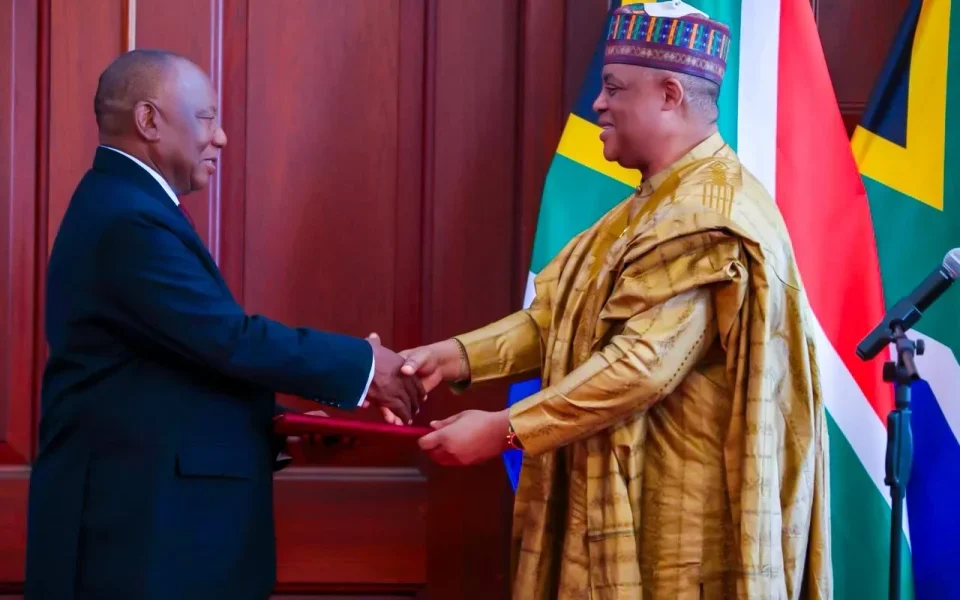
South Africa’s public broadcaster, the South African Broadcasting Corporation (SABC), has disclosed that Nigeria’s High Commissioner to the country, Femi Fani-Kayode, declined an interview invitation following his protest over the omission of his speech from a livestream of a diplomatic ceremony hosted by President Cyril Ramaphosa.
In a statement issued on Sunday, the broadcaster said it regretted the envoy’s decision but remained willing to engage with him and the Nigerian High Commission.
The development followed Fani-Kayode’s complaint that his introduction and address were excluded from the livestream of the presentation of letters of credence ceremony held at the Sefako Makgatho Presidential Guest House in Pretoria on Friday.
“We regret that the High Commissioner declined an interview with SABC News, reportedly because of his dissatisfaction with the livestream of the ceremony. We respect his decision and remain open to engaging with him and the Nigerian High Commission,” the broadcaster stated.
However, the SABC did not directly address the allegation that Fani-Kayode’s presentation was deliberately omitted from the livestream.
Instead, it rejected being described as a state broadcaster, insisting that it operates as a public service media organisation committed to independent, impartial and credible journalism.
“Two points need clarifying. First, the SABC is a public service media, not a state broadcaster. Our mandate is to serve the public interest through independent, impartial and credible journalism. The Presidency’s livestream arrangements and SABC News’ editorial coverage are separate matters.
“Secondly, SABC News did cover the ceremony. It was carried on the SABC News LIVE channel on SABC+, and the High Commissioner’s arrival was shown during a live crossing on the SABC News Channel (DStv Channel 404). We also published a clip on our official X account of the High Commissioner speaking to President Cyril Ramaphosa,” the statement added.
The broadcaster reaffirmed its commitment to fairness, impartiality and editorial independence, while expressing its desire to maintain its longstanding relationship with Nigeria.
Earlier, Fani-Kayode had accused the South African Presidency of deliberately excluding Nigeria’s delegation from the livestream of the ceremony, which involved 15 ambassadors presenting their letters of credence to Ramaphosa.
According to the Nigerian envoy, the introductions and speeches of 14 other ambassadors were broadcast, while Nigeria’s segment was omitted, with the livestream resuming only after he had finished his address.
He also confirmed that he declined an interview offered by SABC News at the venue because he was unhappy with what he described as the treatment of the Nigerian delegation.
However, the South African Presidency subsequently published the full recording of the ceremony, including Fani-Kayode’s speech, on its official YouTube channel.
The controversy also triggered a public exchange between the Nigerian High Commission and Vincent Magwenya, spokesperson for President Ramaphosa.
Magwenya disputed Fani-Kayode’s account of the President’s intervention, insisting that Ramaphosa had not interfered in the broadcaster’s operations or editorial decisions.
He explained that the South African leader had merely directed the Nigerian envoy to the appropriate SABC official to address his complaint.
The Nigerian High Commission, however, stood by Fani-Kayode, maintaining that the envoy and Nigeria had been treated with contempt and insisting that Ramaphosa had intervened to resolve the matter.
The diplomatic disagreement comes amid renewed concerns over xenophobic attacks against Nigerians and other African migrants in South Africa.
Nigeria has repeatedly raised concerns about the safety of its citizens in the country following reports of killings, harassment and attacks targeting foreign nationals.
In September, Nigeria’s National Assembly suspended official visits to South Africa over anti-migrant violence, while Nigerian authorities reported that 98 citizens had died in mob or hate-related incidents in the country since 2022.