
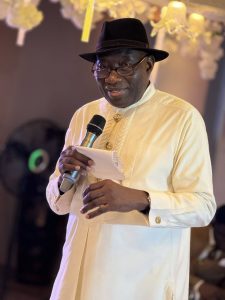
Former President Goodluck Jonathan has revealed that the recent military takeover in Guinea Bissau caused him deeper pain than his electoral defeat to Muhammadu Buhari in 2015.
According to Saturday PUNCH, Jonathan said the incident was particularly distressing given his long-standing efforts to stabilise and democratise the West African nation. He had travelled to Guinea Bissau as part of the West African Elders Forum to observe ongoing presidential and parliamentary elections when the military abruptly claimed power—while observer teams from ECOWAS, AU, and others were still on duty.
The sudden development left Jonathan and his team stranded and raised concerns about their safety until he was evacuated on Thursday.
“What happened in Guinea Bissau is quite disturbing to me, a person who believes in democracy,” Jonathan said. “In fact, I feel more pain than the day I called Buhari to congratulate him when I lost the election as a sitting president.”
He recalled his long involvement in helping Guinea Bissau stabilise after its 2012 crisis and noted that he had personally supported efforts leading to the successful 2013 elections.
Jonathan questioned the nature of the so-called coup, describing it as “bizarre” and unlike any he had seen. He criticised President Umaro Embaló for prematurely announcing his own “arrest” while still speaking freely to global media on his phone—an action Jonathan said contradicted every known pattern of a real military coup.
He cited reports from ECOWAS, AU, and other observers confirming peaceful elections, raising further doubts about Embaló’s claim.
“It was President Embaló who announced the coup before the military later came up to say they were in charge,” Jonathan said. “Not only that, he was speaking to the world using his phone. That is not how coups work.”
The former president urged against using force to challenge the military and called on ECOWAS and AU to publish the full election results. He also demanded the release of detained opposition leader Fernando Dias, insisting he committed no offence.
Jonathan recounted how he was eventually evacuated by an aircraft sent by Côte d’Ivoire, which secured clearance ahead of Nigeria due to proximity and regional ties. Although Nigeria later received approval to deploy its own plane, Jonathan’s team advised Abuja to stand down since the Ivorian aircraft was already near.
He returned to Nigeria aboard the Ivorian plane, as seen in photos of his arrival.
