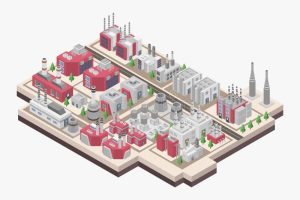
Boeing’s Everett campus in Washington State is less a warehouse and more a working town under one roof. The building’s volume reaches about 13.4 million cubic meters, which puts it in a category of its own. That sheer size serves a purpose: wide-body jets need space, height and predictable flows.
Roughly 30,000 people clock in here across three shifts, making Everett the biggest single industrial employer in Snohomish County.
Daily life under one roof
Staff move by bike or electric cart. Visitors often notice that you don’t just “walk across” Everett; you plan your route like a commute. The amenities mirror that reality:
a fire station that drills for aviation-grade emergencies
a medical center for rapid on-site care
a power plant that stabilizes energy demand
a 3,000-seat cafeteria and smaller canteens near the lines
a convenience store and tool cages that issue calibrated gear
break rooms with games and small stages for team briefings
about 3.7 km of pedestrian tunnels that keep traffic off the floor
Veterans tell stories about “indoor weather.” With volumes that large, moisture can pool at the ceiling. On rare days, condensation has fallen like a brief indoor drizzle. Humidity control now sits on the checklist like any other constraint.
The hall measures over 35 meters to the trusses, tall enough to stand tail fins upright during assembly.
Where jumbo jets are born
Everett’s legacy began with the 747 program in the late 1960s and grew with 767, 777 and 787 lines. The building kept stretching, then stretching again, to fit new wingspans and tooling. Today, the site can stage multiple programs without dismantling lines.
At peak cadence, Everett can build up to eight airplanes in parallel, moving them nose-to-tail through stations like a rolling factory.
A production dance that never stops
Parts arrive by road, rail and air. Oversize sections fly in aboard the Dreamlifter. Teams set fuselage barrels, join wings, route miles of wiring, pressure-test hydraulics, then hang engines. Overhead cranes ride roughly 50 kilometers of steel rail and position loads with millimeter accuracy. The flow looks calm, but every task runs on a clock. If a torque wrench misses a minute, the next station feels it.
The output tells its own story. Everett delivered 1,574 747s before that line closed. It has built more than 1,300 767s, including freighters and military variants. The 777 family passed 1,700 frames, with the 777X adding folding wingtips to fit airport gates. The 787 program began here before consolidating final assembly elsewhere, though Everett still supports major work. A fresh line for 737 MAX has been studied to relieve pressure at Renton as airlines refresh fleets.
Jobs, suppliers and the local wallet
A single wide-body order ripples across continents. One 767 freighter can list near B120 million. A 777X can exceed €400 million, depending on configuration. Each aircraft ties into hundreds of suppliers for composites, avionics, interiors and fasteners. In 2024, U.S. aerospace exports cleared N100 billion, with Everett’s metalwork a visible share of that pipeline.
Paychecks travel too. Everett supports machine shops in the valley, software firms in downtown Seattle and logistics yards by the port. Training programs in the region focus on airframe assembly, nondestructive testing and quality inspection, because the lines need skills more than slogans.
Visitors welcome, scrutiny constant
A public gallery—Future of Flight—brings in around 150,000 people a year. Displays trace the steps from raw material to the paint bay. From the mezzanine, the scale lands quickly when you see three tails in a row and they all look huge.
Yet the plant remains a workplace first. Safety and quality sit front and center. Recent years brought tough questions about process discipline and schedule pressure, including on the 787. The FAA has run audits. Boeing says it has tightened checks, added inspections and simplified some work packages. The culture push shows up in stand-up meetings and station boards, not just in press releases.
Scale versus the next generation of aircraft
Everett’s strength is scale. The open floor lets teams re-sequence work, slide jigs, and keep lines running while upgrading tools. The question now: does the next era need one giant hall, or several flexible halls stitched together by digital planning?
Hydrogen, hybrid and modular lines
Hydrogen concepts change more than the engine. Tanks swell, systems reroute, and safety clearances expand. Hybrid-electric designs push different thermal and weight constraints. That could favor modular cells over a single cathedral. Everett can still adapt, but it may share future programs with newer buildings designed for cryogenic handling, battery fire zones and fast-change tooling.
Why the height and volume actually matter
Clearance saves time. Crews can stand a vertical tail without shuffling parts sideways. Cranes clear entire fuselage sections without breaking down tooling. Airflow stays smoother, which reduces dust risk on composite layups. The roof height also keeps noise down at the floor by letting heavy sounds dissipate before they rebound.
What visitors miss from the balcony view
Torque traceability: every critical bolt stores a digital signature for inspectors.
Wiring maps: harness teams route bundles in patterns designed for rework access.
Quality gates: stations cannot push a jet forward until green checks align.
Supplier kitting: trolleys arrive with just the parts for that day’s job to cut errors.
Risks and advantages that come with a mega-factory
Scale concentrates risk. A disruption—an audit hold, a parts shortage, a weather event—can ripple across eight airplanes at once. The benefit cuts the other way: when a fix lands, teams spread it fast and recover cadence quicker than small sites could. Cybersecurity sits high on the risk list as paperwork, torque logs and nonconformance data now travel on networks.
Two quick ways to size this place in your head
Think about a standard Olympic pool at 50 by 25 by 2 meters. That equals 2,500 cubic meters. At that depth, Everett’s volume equates to around 5,360 pools. The common benchmark uses deeper pools for diving—about 3 meters—so 13.4 million cubic meters comes out near 3,573. Change the depth a little and you land near 3,753, which explains why claims vary by source.
Another mental model: stack eight Boeing 777s nose-to-tail with wings spread. You still have room to walk around them. That walkway space is where tools, parts carts and people turn minutes into progress, one station at a time.