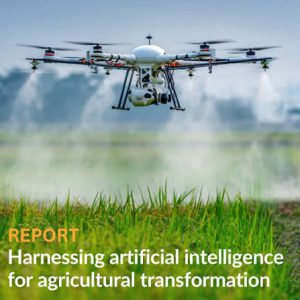
Thisreportpresentsacomprehensiveanalysis of how AI can be responsibly deployed across agrifood systems, especially in low-and middle-income countries. It provides a roadmap of applications, requirements, and investment priorities focusing on ethical, inclusive, and scalable use.
• AI can transform agricultural production for smallholder farmers in low- and middle-incomecountries– helpingfeedthe world, strengtheningclimateresilience, and easing workonthefarm. Buttoachievethis, AI must be used where it truly adds value.
• AI can improve agrifood systems, but only with the right investments in infrastructure, governance, skills, and a focus oninclusionandethics. Thisisessentialfor small-scaleproducers– whogrowathirdof the world’s food – to truly benefit.
• Governments, development partners andtheprivatesectormustcollaborateand invest to realize AI’s potential to increase productivity and advance climate adaptation and equity. No one player within the value chain can do this alone.
The report includes 60 AI use cases across the agrifood value chain, showing why they matter and how they can be adaptedto different low- andmiddle-income country contexts. These include:
• Crops and livestock – accelerating research to find climate-resilient seeds and better breeding methods.
• Advisory and farm management – helping farmers make smarter decisions using AI for pest detection, precision farming, and real-time soil monitoring.
• Markets, distributionandlogistics– improvingmarkettransparencyandreducing spoilage with AI-enabled traceability, price forecasting, and smart contracts.
• Inclusive finance and risk mitigation – expanding financial access through alternative credit scoring and climate-indexed insurance models.
• Cross-cutting applications – supporting planning with tools such as synthetic data, agroecological zoning, and granular weather prediction.
Recommendation
Policy makers:
• Adopt national AI strategies inclusive of agriculture, with clear implementation pathways and budgets.
• Embed AI in AgriFood System Policy by linking it to resilience, climate adaptation, and nutrition security goals.
• Foster Open and Interoperable Data Ecosystems by supporting Agricultural Data Exchange Nodes and FAIR data principles.
Development institutions:
• Integrate digital public infrastructure andAIInvestmentsinagricultureprojects, ensuring that identity, payments, and data infrastructures are AI-ready.
• SupportAIreadinessassessmentsand policy diagnostics for low- and middle-income governments, especially in fragile or climate-vulnerable regions.