
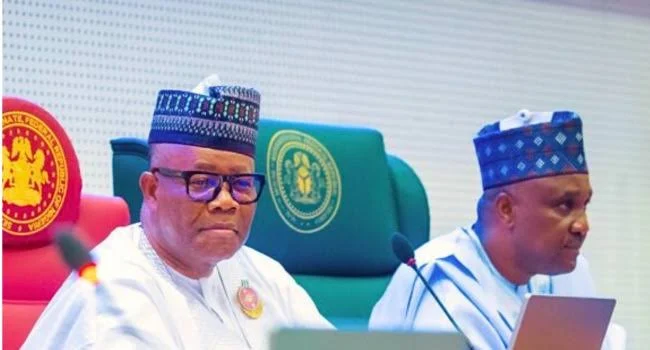
In a major fiscal overhaul, the National Assembly on Tuesday approved a revised N43.5 trillion 2024 Appropriation Act and a reworked N48.3 trillion 2025 budget framework, extending the 2025 fiscal year to March 31, 2026. The move is aimed at addressing revenue shortfalls, weak capital execution, and the long-standing problem of overlapping budget cycles.
The approval followed marathon plenary sessions in both chambers, culminating in the passage of the Appropriation Act (Repeal and Re-enactment) Bills for the 2024 and 2025 fiscal years, which were submitted to the legislature by President Bola Ahmed Tinubu last Friday.
At the Senate, the revised budgets were endorsed after adopting a consolidated report from the Committee on Appropriations, presented by its chairman, Senator Solomon Adeola (Ogun West). Lawmakers said the exercise was designed to align Nigeria’s budget structure with current fiscal realities, address implementation gaps, and restore discipline to the budgeting process.
Adeola explained that the bills repeal earlier budget provisions and replace them with figures that reflect prevailing revenue constraints, debt sustainability concerns, and emerging national priorities. The 2024 Appropriation Act, originally N35.005 trillion, was re-enacted at N43.561 trillion, with statutory transfers, debt servicing, recurrent, and capital expenditure fully detailed in the committee’s report.
For 2025, the previous N54.99 trillion budget was revised to N48.316 trillion, with part of the capital expenditure deferred to the 2026 fiscal year due to funding limitations highlighted during the presidential budget presentation. The committee said extensive consultations with the economic management team informed the decision, focusing on revenue performance, debt exposure, and effective implementation.
Key adjustments included an additional N8.5 trillion for the 2024 capital budget to fund security, humanitarian, and economic interventions. For 2025, N6.674 trillion was removed from capital allocation and deferred to 2026 to enhance budget effectiveness amid anticipated revenue improvements.
Adeola also cautioned against running multiple budget cycles concurrently, stressing that overlapping budgets undermine fiscal discipline, transparency, and accountability. Based on the findings, the committee recommended, and the Senate approved, the revised 2024 and 2025 budgets, extending the 2025 fiscal year to March 31, 2026.
The House of Representatives followed suit, passing the revised N43.56 trillion 2024 budget and the N48.31 trillion 2025 framework after adopting the report of its Appropriations Committee and completing clause-by-clause consideration.
A breakdown of the revised 2024 budget shows N1.74 trillion for statutory transfers, N8.27 trillion for debt servicing, N11.26 trillion for recurrent expenditure, and N22.27 trillion for capital expenditure and development funds. For 2025, allocations include N3.64 trillion for statutory transfers, N14.31 trillion for debt service, N13.58 trillion for recurrent expenditure, and N16.76 trillion for capital projects, with implementation extended into 2026.
In his communication to the National Assembly, President Tinubu said the revisions were necessary to incorporate previously omitted budget items and adjust capital implementation targets in line with Nigeria’s revenue realities and execution capacity. He noted that extending the 2025 budget allows ministries, departments, and agencies sufficient time to utilize the targeted 30 percent capital release.
The president described the revisions as part of a broader fiscal reform agenda aimed at correcting structural flaws in Nigeria’s budgeting process, ending the practice of overlapping budgets, improving planning, enhancing implementation, and strengthening transparency and accountability in public spending. He added that the framework is designed to deliver credible budget performance, better coordination of government programmes, and improved value for money for Nigerians.
