
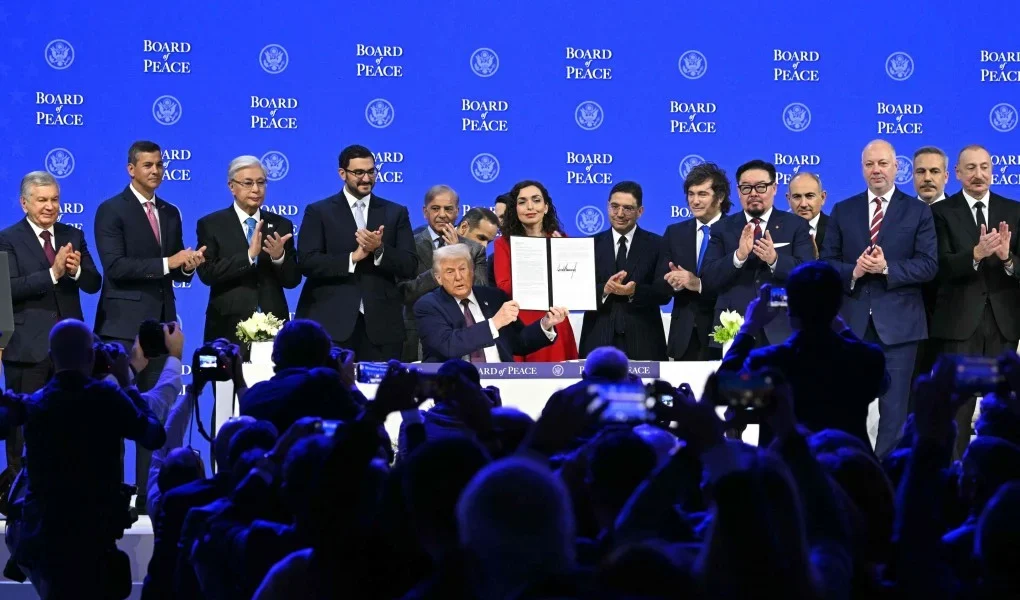
U.S. President Donald Trump has officially launched his “Board of Peace,” a new international initiative originally created to support the fragile ceasefire in Gaza but one he claims could eventually take on broader global conflicts — raising concerns among some countries that it may challenge the United Nations’ role in international diplomacy.
Trump announced the board during an event held alongside the World Economic Forum in Davos, insisting the body would work with the UN rather than replace it. He described the United Nations as an organisation with “great potential” that has not been fully utilised, arguing the new board could strengthen global peace efforts by complementing existing institutions.
However, Trump’s suggestion that the board could expand beyond Gaza has unsettled several nations, including long-time U.S. allies, who fear an enlarged mandate could weaken the UN’s authority as the main platform for conflict resolution and multilateral negotiation.
So far, roughly 35 countries have signed on to the initiative, including Israel, Saudi Arabia, Turkey, Argentina and Indonesia. Russia has indicated it is considering joining, while some Western governments remain hesitant. France has declined to participate, Britain has said it will not join for now, and China has yet to declare its position.
Trump has said that any permanent member of the Board of Peace would be expected to contribute $1 billion in funding. Yet at the signing ceremony, there were no clearly visible representatives from major global powers. Russian President Vladimir Putin said Moscow was reviewing the proposal and suggested that frozen Russian assets in the United States could potentially be used to finance its contribution, while also supporting Palestinians.
U.S. Secretary of State Marco Rubio said the board’s immediate priority would be ensuring the Gaza peace plan is fully implemented, adding that the initiative could serve as a blueprint for resolving conflicts elsewhere. The board’s establishment has been backed by a UN Security Council resolution connected to Trump’s Gaza proposal, though the UN has stressed its involvement would remain limited to that framework.
While some democracies have signed on, many participating states are not democratic and include leaders seen as closely aligned with Trump’s approach to international diplomacy. Confirmed members include Rubio, Trump’s Gaza negotiators Jared Kushner and Steve Witkoff, as well as former British Prime Minister Tony Blair.
Meanwhile, attention remains on Gaza’s fragile ceasefire. Kushner said the next phase would focus on raising funds for reconstruction and addressing the disarmament of Hamas, which he described as a major barrier to lasting peace. He added that humanitarian assistance would remain the immediate priority, alongside efforts to create conditions for long-term stability.
There have been signs of limited progress. Palestinian officials say the Rafah border crossing with Egypt is expected to reopen next week. Still, the ceasefire — agreed in October — has repeatedly come under strain, with both Israel and Hamas accusing each other of breaches, including disputes over hostages, aid delivery and continuing violence.
Israeli Prime Minister Benjamin Netanyahu has accepted an invitation to join the board, while Palestinian factions have endorsed the peace plan and backed the creation of a transitional Palestinian committee to administer Gaza under the board’s oversight. Even if the current truce holds, future negotiations are expected to confront deeply rooted issues, including Hamas disarmament, Gaza security arrangements, and a possible Israeli withdrawal.

