Residents in Iran say daily life has become increasingly tense and uncertain as the United States and Israel intensify their military campaign against the country. People in the capital, Tehran, describe a city gripped by fear, smoke and quiet streets as airstrikes continue and uncertainty grows about how the war will unfold.
The conflict has escalated in recent days, particularly after Mojtaba Khamenei, son of the late Ayatollah Ali Khamenei, was appointed Iran’s new supreme leader following his father’s death during the opening phase of the US-Israeli attacks.
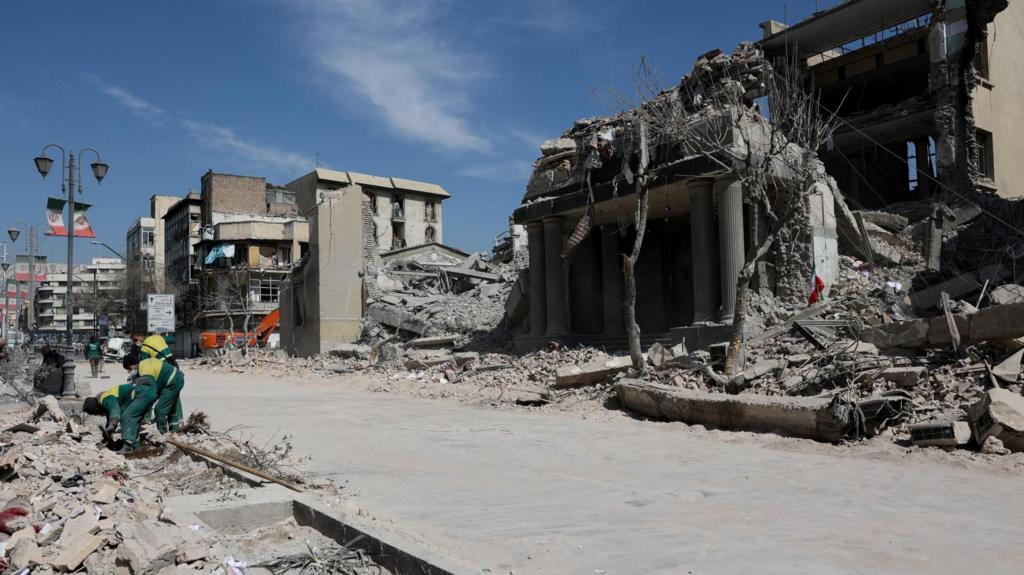
Over the weekend, Israeli airstrikes targeted several oil depots in Tehran, triggering massive fires that sent thick black smoke across the capital. Residents said the bombardment was among the most intense since the war began.
People living in Tehran told reporters that the city was unusually quiet on Monday. Many residents have either fled the capital or remain indoors out of fear of further strikes. Although rainfall helped reduce some of the smoke from the burning oil facilities, the smell and haze continued to hang over parts of the city.
“The city is almost emptied out. Shops are open hoping against hope for customers, but many people have left Tehran,” said a resident identified as Amir. “Most of the time it’s just silence unless there’s an attack.”
Communication with people inside Iran has also become more difficult due to widespread internet restrictions imposed by the government. Some residents, however, have briefly managed to connect to the outside world using satellite internet services and virtual private networks.
Reports from inside the country indicate that normal routines have been heavily disrupted. Bakeries have seen long queues, while checkpoints and security patrols have increased throughout the capital.
One resident described the atmosphere as tense despite the quiet streets.
“The air is heavy,” she wrote on social media. “Tehran smells of smoke, metal and fuel — like a city trapped under a giant glass dome. The streets are emptier than ever, but the city isn’t calm.”
The appointment of Mojtaba Khamenei as supreme leader has also triggered strong reactions among many Iranians. The decision was made by the Assembly of Experts, the clerical body responsible for selecting the country’s highest authority.
Some residents, speaking anonymously, said they were shocked by the decision and feared it could make the conflict harder to resolve. Many believe the new leader, widely viewed as a hardliner, may continue the same strict policies and confrontational approach as his father.
For some Iranians critical of the government, the situation has created a sense of being caught between the state and the war.
“Most of us feel trapped between an oppressive regime and warmongers in Israel and the U.S.,” Amir said. “The hardliners have succeeded in putting their own man in power at a time when civil society has little influence.”
Despite such criticism, the government still appears to retain support among parts of its conservative base. Thousands of people gathered in several cities to celebrate Mojtaba Khamenei’s appointment as the country’s new leader.
Meanwhile, security forces have increased their presence in Tehran, with reports of paramilitary units, plainclothes officers and anti-riot forces deployed at key locations across the city.
The war has already caused significant casualties. Iranian officials say more than 1,000 people have been killed since the United States and Israel began bombing the country on February 28.
One of the deadliest incidents occurred when a missile struck a school in the southern city of Minab, killing more than 160 schoolgirls. Several media investigations suggest a US weapon may have been responsible for the strike, although President Donald Trump has blamed Iran.
While many residents fear the war will bring further destruction, others see the conflict as a potential turning point. Some Iranians have expressed support for the attacks, hoping they could weaken the Islamic Republic and eventually lead to political reform.
“Everyone in Iran rejoiced over Khamenei’s death, especially families whose children were killed in protests,” one woman said, adding that she believes the conflict could open a path toward freedom.
However, some analysts warn that the worst-case scenario would be a prolonged war that devastates the country while leaving the current political system largely unchanged.