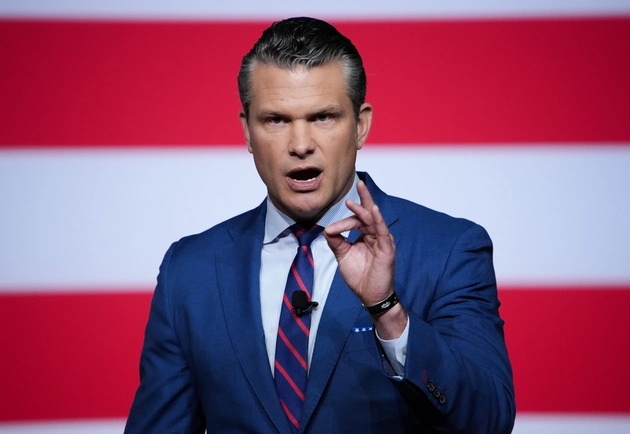
U.S. Defense Secretary Pete Hegseth said on Tuesday, March 10, that American forces are preparing for what he described as the most intense wave of attacks yet in the ongoing war with Iran.
Speaking during a Pentagon briefing alongside Chairman of the Joint Chiefs of Staff Gen. Dan Caine, Hegseth stated, “Today will once again be our most intense day of strikes inside Iran.”
His remarks come on the tenth day of the military campaign known as Operation Epic Fury, launched on February 28 by the United States and Israel. The operation has targeted Iranian military bases, weapons facilities, and government infrastructure.
“Iran stands alone, and they are badly losing on Day 10 of Operation Epic Fury,” Hegseth said.
According to the defense secretary, U.S. forces plan to increase airpower by deploying additional fighter jets and bombers as part of efforts to achieve key military objectives. These include destroying Iran’s missile stockpiles and production capabilities, weakening its naval forces, and preventing the country from acquiring nuclear weapons.
“We’re crushing the enemy with an overwhelming display of technical skill and military force,” Hegseth said. “We will not relent until the enemy is completely and decisively defeated.”
Despite the escalation, Hegseth stressed that the United States does not intend to engage in long-term nation-building operations similar to those seen in Iraq and Afghanistan.
His comments echoed earlier remarks by President Donald Trump, who suggested the conflict could end sooner than expected due to the rapid destruction of Iranian military assets.
Trump also issued a warning to Iran regarding global oil supplies. In a post on Truth Social on Monday night, he said the United States would respond strongly if Iran attempted to disrupt shipping through the Strait of Hormuz, a critical route for global oil transport.
“If Iran does anything that stops the flow of oil within the Strait of Hormuz, they will be hit by the United States of America twenty times harder than they have been hit thus far,” Trump wrote.
Hegseth added that the direction and pace of the war ultimately depend on the president.
“President Trump controls the throttle,” he told reporters. “He’s the one deciding when we’ve achieved specific objectives.”
The conflict has already spread beyond Iran’s borders. Authorities in Abu Dhabi confirmed on Tuesday that an Iranian drone attack triggered a fire at the Ruwais Industrial Complex oil refinery, though no injuries were reported.
The war has also entered a new political phase after Mojtaba Khamenei was named Iran’s new supreme leader following the death of his father, Ayatollah Ali Khamenei, during the initial wave of strikes.
Reacting to the appointment in a television interview, Trump said he doubts the new Iranian leader will be able to maintain stability.
“I don’t believe he can live in peace,” Trump said.
However, the president suggested that diplomatic communication may still be possible, adding that Iran’s leadership appears interested in negotiations.
“I’m hearing they want to talk badly,” he said.
During the Pentagon briefing, Hegseth also issued a warning to Iran’s new leadership, urging them to abandon any pursuit of nuclear weapons.
“He would be wise to heed our president and not pursue nuclear weapons,” Hegseth said.