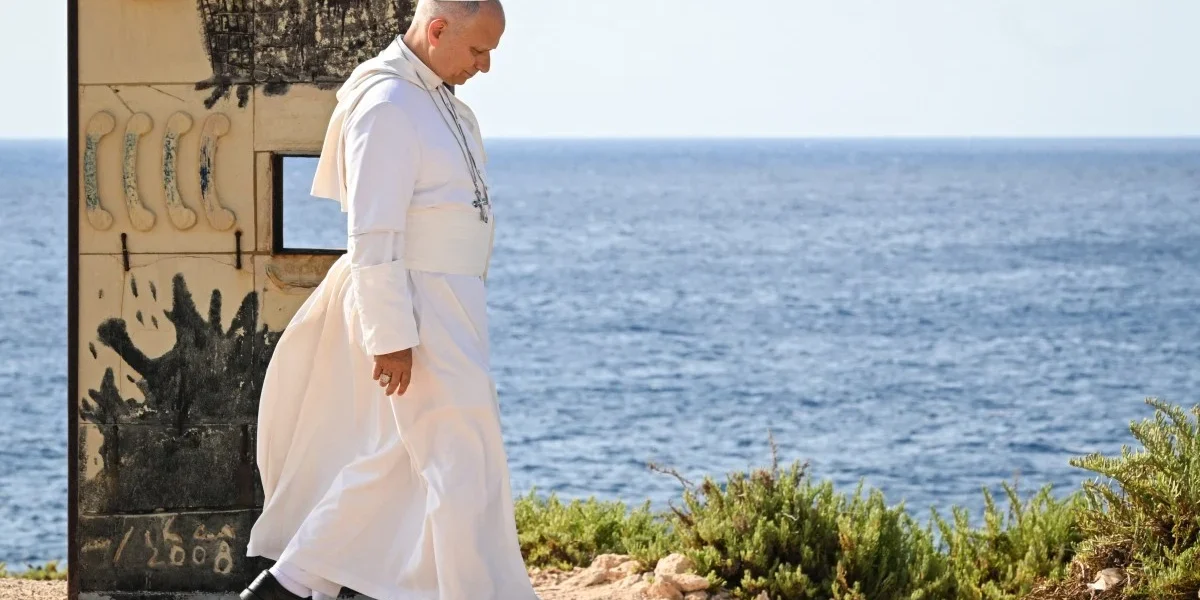
Pope Leo XIV on Saturday visited the Italian island of Lampedusa, one of Europe’s main arrival points for migrants crossing the Mediterranean from Africa, in a visit widely seen as a strong message on migration to leaders in the United States and the European Union.
The first American-born pope chose to spend July 4 — the 250th anniversary of US independence — on the migration frontline. His visit comes amid ongoing criticism of US President Donald Trump’s immigration policies and just weeks after the European Union approved new migration rules that expand detention powers and allow deportation centres to be established outside the bloc.
Leo began the trip by praying at a cemetery where unidentified migrants are buried in numbered graves. He later visited the “Door of Europe,” a monument honouring migrants who have died or risked their lives crossing the Mediterranean, and briefly met with a migrant family.
Since becoming pope, the Chicago-born pontiff has made the protection of migrants a central theme of his papacy, following in the footsteps of his predecessor, Pope Francis. He has repeatedly praised those who assist vulnerable migrants while condemning mass deportations and harsh immigration policies.
During the half-day visit, the 70-year-old was expected to renew calls for safer and legal migration pathways, stressing the need for greater compassion and international responsibility.
His presence on Lampedusa sends “a clear message at a time when the global political debate on migration is often framed around borders and deterrence rather than protection and shared responsibility,” Filippo Ungaro, spokesperson for the UN refugee agency (UNHCR), told AFP.
Lampedusa, located about 145 kilometres (90 miles) from Tunisia, has long served as a symbol of both the humanitarian crisis in the Mediterranean and the generosity of local residents who have welcomed thousands of migrants while mourning those who never survived the journey.
The island witnessed its deadliest tragedy in 2013 when more than 360 migrants died in a shipwreck. Many more have lost their lives on the route in the years since.
After visiting the cemetery and the “Door of Europe,” Leo travelled to the island’s dock, where migrants rescued by the coastguard and humanitarian organisations are brought ashore. He was scheduled to bless a plaque dedicated to Pope Francis, who made Lampedusa the destination of his first papal trip in 2013, before celebrating Mass at a nearby sports field.
“Lampedusa is a place of particular significance. We are here to bear witness to its commitment to welcoming those seeking a better life,” said Vanda Mainardi, a 65-year-old pilgrim who travelled from northern Italy to attend the papal visit.
The 20-square-kilometre island is the second major European migration hotspot Leo has visited since becoming pope. During a trip to Spain’s Canary Islands last month, he strongly criticised human traffickers and reiterated his opposition to policies that target undocumented migrants.
He has previously described the treatment of migrants by the US administration as “inhuman” and, in a speech marking America’s 250th Independence Day on Friday, called for greater moderation in political discourse while recognising the vital role successive waves of immigrants have played in shaping the United States.
According to the International Organization for Migration (IOM), the Central Mediterranean route remains the world’s deadliest migration corridor. About 1,330 people died or disappeared while attempting the crossing last year.
Salvatore Sortino, director of the IOM Coordination Office for the Mediterranean, said the figures highlight the urgent need to strengthen search-and-rescue operations.
The route is monitored by a small number of humanitarian rescue vessels, whose operators have repeatedly accused European authorities of failing to do enough to prevent deaths at sea.
UNHCR data show that more than 14,000 migrants arrived in Italy during the first six months of the year, with most departing from Libya. Nearly 60 per cent landed on Lampedusa.
Although significant, the arrivals remain well below the levels recorded during the 2011 Arab Spring, when tens of thousands of migrants reached the island within months as maritime border controls collapsed across parts of North Africa.