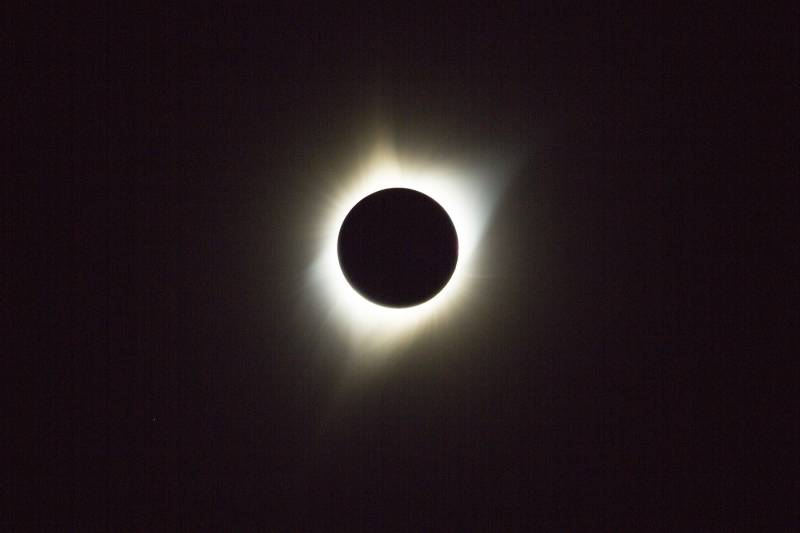
A rare total solar eclipse will cast parts of northern Spain into darkness on August 12 as the Moon completely obscures the Sun, marking the first total solar eclipse visible from mainland Europe since 2006.
A total solar eclipse occurs when the Moon passes directly between the Earth and the Sun, blocking sunlight and casting a narrow shadow across the Earth’s surface. During the brief period of totality, daytime turns to twilight, temperatures may drop, shadows become unusually sharp, and some animals begin behaving as though night has fallen.
According to NASA, the phenomenon is possible because of a remarkable alignment in space. Although the Sun is about 400 times larger than the Moon, it is also approximately 400 times farther away from Earth, making both appear almost the same size in the sky. This allows the Moon to completely cover the Sun and reveal its outer atmosphere, known as the corona.
The eclipse will begin over a remote region of northern Russia before its path of totality crosses Greenland, Iceland, Spain and the northeastern tip of Portugal. In Spain, the eclipse will sweep from the northern city of Oviedo to the island of Mallorca.
Observers in Spain are expected to experience less than two minutes of total darkness shortly before sunset. In Burgos, for instance, totality is forecast to last one minute and 48 seconds. While the eclipse will last slightly longer in parts of Russia and Greenland, totality will still remain under two and a half minutes.
Before and after totality, a partial solar eclipse lasting about one hour and 45 minutes will be visible. Partial phases of the eclipse will also be seen across much of Europe, Canada, the northern United States and northwestern Africa.
Although one or two solar eclipses occur somewhere on Earth every year, total solar eclipses are rare for any single location because the Moon’s shadow follows a relatively narrow path. Some places can go centuries before witnessing another total eclipse.
Spain is set to enjoy another spectacular celestial event on August 2, 2027, when a total solar eclipse will cross southern Spain, northern Africa and the Arabian Peninsula. The event has been dubbed the “eclipse of the century” by some experts because totality is expected to last six minutes and 23 seconds, making it the longest total solar eclipse of the 21st century.
The country will also experience an annular, or “ring of fire,” solar eclipse on January 26, 2028, when the Moon will cover the centre of the Sun while leaving a bright ring of sunlight visible around its edges.
Astronomers and health experts have warned the public never to look directly at the Sun during any phase of a solar eclipse without certified eye protection, as doing so can cause permanent eye damage.
They recommend using eclipse glasses that comply with the ISO 12312-2:2015 international safety standard, which filters harmful ultraviolet and infrared radiation.
Experts also caution that eye damage may not be immediately noticeable because the eyes do not contain pain receptors. Following the 2024 total solar eclipse in the United States, researchers reported a significant increase in online searches for phrases such as “my eyes hurt,” highlighting the risks of viewing the event without proper protection.