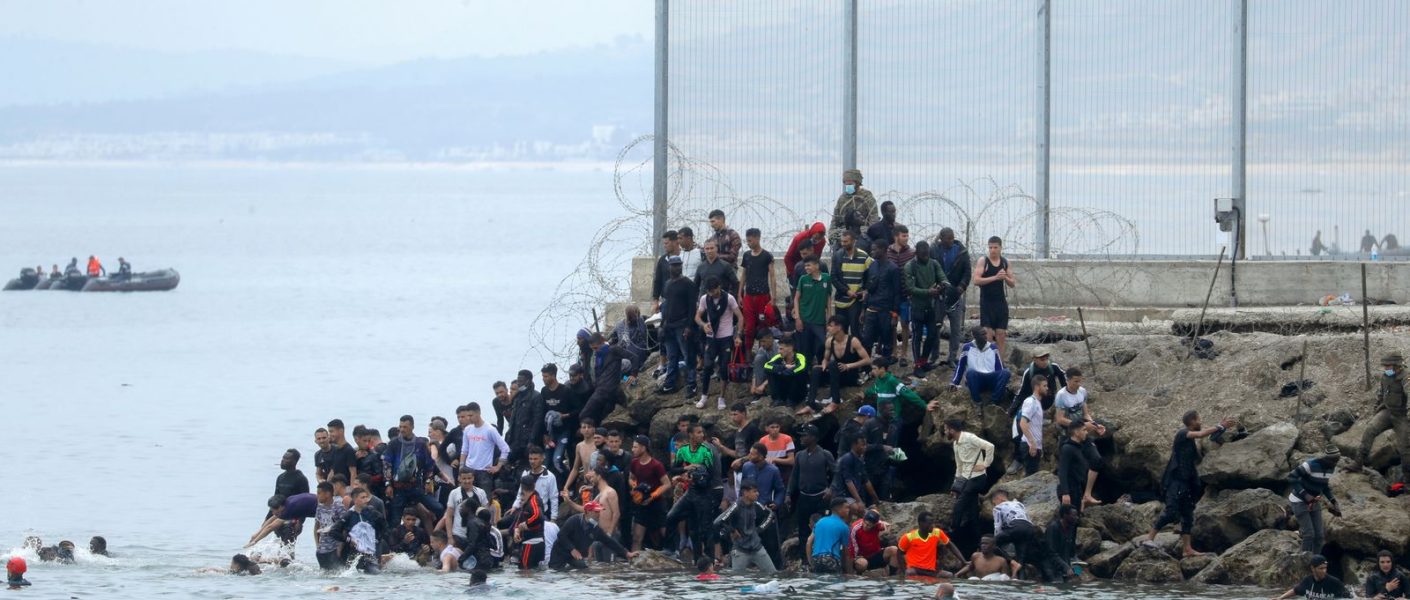
Italy has temporarily suspended Schengen border-free travel with Spain after a massive influx of migrants into the Spanish enclave of Ceuta sparked a humanitarian and political crisis across Europe.
According to Spanish authorities, up to 60,000 migrants crossed into Ceuta from Morocco within 24 hours, while at least 60 people reportedly died attempting the dangerous journey.
Spanish Prime Minister Pedro Sánchez described the unprecedented influx as “a violation of Spain’s territorial integrity” and vowed to use all available resources to protect residents of the enclave, which is home to around 85,000 people.
Sánchez blamed organised human trafficking networks for exploiting a recent Spanish Supreme Court ruling that limits the immediate return of migrants intercepted while attempting to reach Ceuta or the nearby Spanish enclave of Melilla.
He announced plans to establish a temporary reception centre to process new arrivals through registration, documentation and screening before expediting the removal of those without legal grounds to remain in Spain.
The Spanish government also plans to install a floating barrier of buoys near Tarajal Beach to clearly mark the maritime border while complying with the Supreme Court’s ruling.
Spain’s Interior Ministry said more than 37,500 migrants had voluntarily returned to Morocco by Friday afternoon after additional police officers and military personnel were deployed to the enclave.
The crisis has prompted a strong response from neighbouring European countries.
Italy announced it would suspend the Schengen free-travel arrangements with Spain for one month, requiring passengers travelling by air or sea between the two countries to present passports. Italian authorities also confirmed they would strengthen border controls with France to prevent undocumented migrants from moving further into Europe.
The decision drew criticism from Madrid after Italian Foreign Minister Antonio Tajani suggested Spain’s migrant regularisation policies had encouraged human trafficking. Spain responded by summoning Italy’s ambassador, with Foreign Minister José Manuel Albares describing the remarks as inappropriate and accusing Italy of engaging in political point-scoring.
The European Commission later clarified that Ceuta and Melilla operate under special Schengen rules that prevent migrants entering the enclaves from travelling freely throughout the wider Schengen area. EU Migration Commissioner Magnus Brunner described the situation as “unacceptable” and said the Commission was working closely with Spanish authorities.
Ireland also expressed support for Spain, with Justice Minister Jim O’Callaghan announcing he had requested an emergency meeting of the European Union’s Integrated Political Crisis Response (IPCR) mechanism to discuss the unfolding situation.
Moroccan officials blamed criminal trafficking networks for orchestrating the crossings and insisted cooperation between Morocco and Spain remained strong.
Meanwhile, humanitarian organisations warned that thousands of migrants, including women and unaccompanied children, were left without shelter, with many sleeping in parks and on pavements throughout Ceuta. Authorities said many of the reported fatalities occurred by drowning during the crossing, while others died in a crush near the border fence at Tarajal Beach.
The latest influx is the largest migration surge into Ceuta since May 2021, when around 10,000 migrants crossed into the enclave over a two-day period.