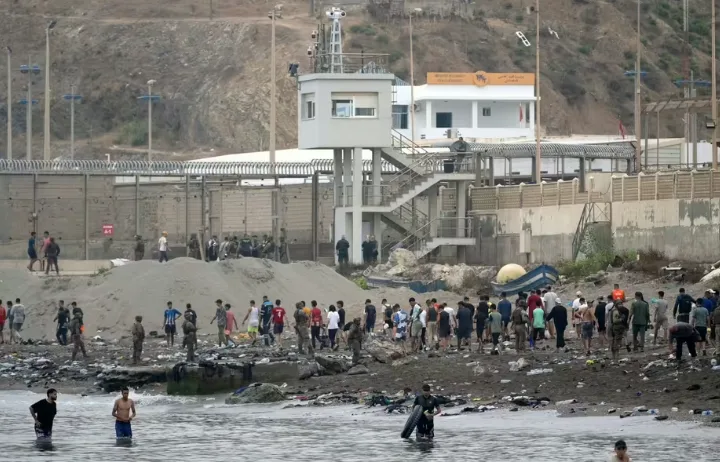
At least 72 people have died following the recent mass influx of migrants into Spain’s North African enclave of Ceuta, where tens of thousands of people—mostly swimming from neighboring Morocco—crossed into the territory over several days, local authorities said on Sunday.
The latest death toll was confirmed by the Spanish government’s delegate to Ceuta, Miguel Ángel Pérez Triano, who told reporters that the number of fatalities had risen from the previously reported 67.
An estimated 60,000 migrants entered Ceuta between Wednesday and Friday in what has become the largest mass crossing ever recorded into the Spanish enclave. However, officials said the vast majority voluntarily returned to Morocco within 48 hours.
By Sunday, the situation in Ceuta had largely stabilized. Spanish police and military personnel continued to patrol the streets, while only a small number of migrants remained in the city.
AFP journalists reported seeing groups of unaccompanied minors sheltering in a disused industrial area, with some sleeping on pavements.
“All the children here want to go to mainland Spain,” said Moroccan migrant Aziz Dabch, 41.
The unprecedented migration surge has triggered diplomatic tensions, with several European countries criticizing Spain’s handling of the crisis.
Near Ceuta’s port, Spanish soldiers detained a group of exhausted migrants while rescue teams patrolled the waters along the border. Authorities also reinforced security by deploying a new 500-metre floating barrier extending into the Mediterranean Sea.
Civil Guard officers were seen escorting migrants back to the border crossing for their return to Morocco, while cleanup crews removed clothing, trash and other debris left behind after the mass crossing.
Spanish authorities blamed criminal networks for spreading false claims that a recent Spanish Supreme Court immigration ruling would make it easier for migrants to enter the country.
Some analysts have suggested Morocco may have relaxed border controls to increase diplomatic pressure on Spain, which has recently strengthened relations with Algeria, Rabat’s regional rival.
A similar situation occurred in 2021, when about 10,000 migrants crossed into Ceuta after Morocco eased border restrictions during a diplomatic dispute with Madrid.
Moroccan authorities have yet to issue an official statement on the latest crisis.
Meanwhile, many migrants said they crossed after hearing rumors that the border had been opened, claims that quickly spread across social media.
The European Union announced it will hold an emergency video conference on Tuesday after 22 member states signed a joint letter calling for a coordinated response to prevent further uncontrolled crossings.
Italy has also suspended its Schengen free-movement agreement with Spain for one month in response to the crisis.
Spanish Prime Minister Pedro Sánchez criticized what he described as the “selfish” response of some EU member states in a letter to European leaders.
Pope Leo XIV also addressed the situation during his Sunday Angelus prayer, saying he was following developments in Ceuta “with concern” and expressing hope for a peaceful and lasting solution.