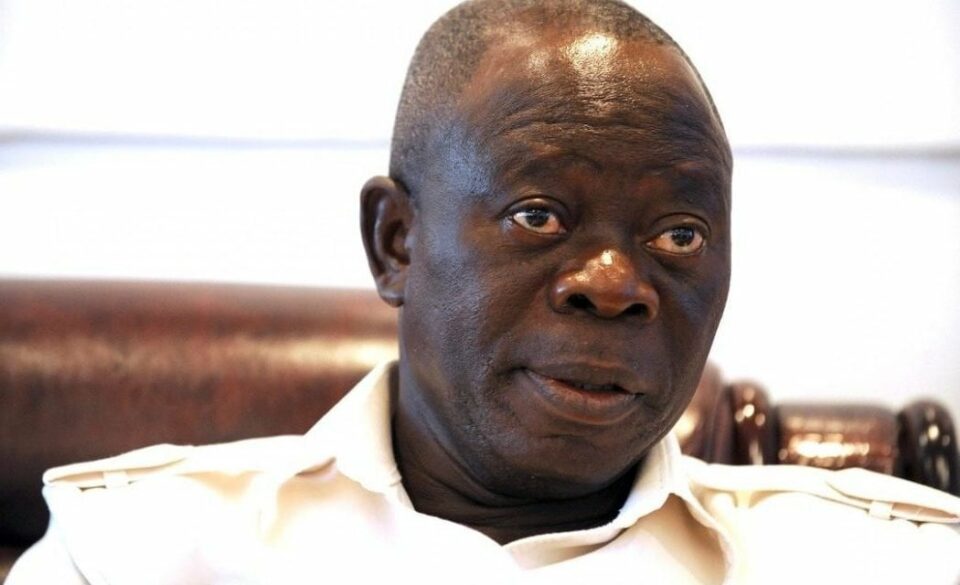
Senator Adams Oshiomhole has revealed that an Italian ambassador once told him that Italian men could not resist Edo women during discussions on efforts to combat human trafficking between Nigeria and Italy.
Oshiomhole made the disclosure during Tuesday’s Senate plenary while calling for stronger cooperation between the Nigerian and Italian governments to address both the demand for and supply of victims of human trafficking. A video of the exchange surfaced online on Thursday.
The former Edo State governor said he had met with the Speaker of the Italian Parliament, who promised to provide technical assistance to Edo State to tackle the supply side of human trafficking.
However, Oshiomhole argued that the Italian government should also discourage its citizens from patronising trafficked women, insisting that efforts to address the problem would remain incomplete without tackling demand.
He said he told the Italian official that Edo State and other affected communities could not effectively address the problem if the demand for trafficked women in foreign countries continued.
“The law of economics is that without demand, there will be no supply, but when demand is strong, supply will find its way. So I think this really is a national problem,” he said.
Recounting his conversation with the Italian ambassador, Oshiomhole said he had urged the diplomat to address the demand side of human trafficking, only for the ambassador to respond: “Your Excellency, I’m sorry, Italian people cannot resist Edo girls.”
Oshiomhole said he rejected the suggestion that the responsibility should rest solely on Edo communities, arguing that Italian men needed reorientation.
“If they cannot resist, they need the reorientation. Let them deal with Italian people and not Edo people,” he said.
The senator added that he would only focus on tackling the supply side if there were clear efforts to address demand, warning against Nigeria being portrayed internationally as a country complicit in human trafficking.
He also called for action against organised groups abroad allegedly involved in facilitating the trafficking of Nigerian women.
During the debate, Senate President Godswill Akpabio asked Oshiomhole whether he had tried to find out what Italian men found appealing about Edo women.
“Seriously, just for the benefit of my colleagues, did you try to find out what the Italians found in the Edo girls?” Akpabio asked.
Oshiomhole responded, “I couldn’t do that because I’m a Catholic and I’m happily married.”
Akpabio subsequently highlighted the need for stronger legal measures to combat kidnapping and related offences, recalling that he signed a law prescribing the death penalty for kidnapping while serving as governor of Akwa Ibom State.
He noted that the law also provided for the forfeiture and demolition of properties used in kidnapping, describing such measures as potential deterrents.
The Senate President called for stricter enforcement of existing laws and improved rehabilitation programmes for trafficking victims returning to Nigeria. He also referenced the need to review relevant legislation, including the Trafficking in Persons (Prohibition) Enforcement and Administration Act, 2015, and the Child Rights Act, 2003.
The Senate subsequently adopted a recommendation to strengthen existing anti-trafficking laws through more effective enforcement and rehabilitation measures.