
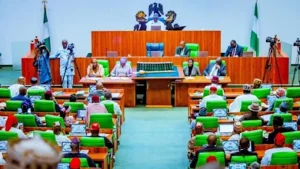
The House of Representatives has demanded details of contracts, capital expenditure and internally generated revenue (IGR) from the National Board for Technical Education (NBTE) as lawmakers examine the agency’s finances and operational challenges, including its claim that it has received no capital funding for two years.
The demand was made on Wednesday during an oversight visit by the House Committee on Federal Polytechnics and Higher Technical Education, chaired by Hon. Fuad Kayode Laguda, at the NBTE headquarters.
The committee also requested a copy of a report by KPMG Advisory Services on the agency’s operations and proposed restructuring, with Laguda assuring that lawmakers would study its findings and recommendations before deciding on appropriate legislative interventions.
Speaking to journalists after the meeting, Laguda said the committee had yet to receive the report, although NBTE management indicated that the assessment had been completed.
“The report from KPMG, we have not seen it; we just heard about it today. That is why we have requested for the report to study it, look at the findings and recommendations before making our conclusions,” he said.
The Federal Government engaged KPMG Advisory Services in August to assess the NBTE and recommend measures to strengthen its governance, organisational structure and regulatory capacity as part of broader efforts to improve technical and vocational education in Nigeria.
Laguda said the committee had also requested additional documents relating to issues raised by the NBTE Executive Secretary, Prof. Idris Muhammad Bugaje, and his management team during the oversight session.
On the agency’s financial difficulties, the committee chairman acknowledged the need for increased government funding but stressed that the board must also explore ways to improve its internally generated revenue.
“The funding of NBTE has to be improved upon; it has to be better and it is a two-way thing—not just what is being received from the government, but also what they are generating,” he said.
He added that lawmakers would examine ways to improve both government allocations and the agency’s revenue-generating capacity, noting that further clarification would be sought before the committee reached conclusions on the required interventions.
During the session, the lawmakers requested details of the NBTE’s capital budget from 2024 to date, records of contracts awarded and information on its internally generated revenue.
Earlier, Bugaje identified inadequate funding as the agency’s principal challenge, telling the committee that the absence of capital releases over the past two years had stalled projects.
“The major challenge affecting the NBTE is funding and we are also working to clamp down on illegal centres; and we are also waiting for the amendment of the NBTE Act, so that it becomes a commission,” he said.
He added that capital projects had been suspended but expressed optimism that funding releases would enable work to resume.
“Capital projects had to be stopped but we are hopeful in coming days we will have releases and work will resume,” Bugaje said.
The executive secretary also disclosed that the KPMG assessment had been completed and recommended a reorganisation of the agency. According to him, the restructuring had resulted in the appointment of two coordinating directors and an expansion of the organisation to 22 departments.
He said the report identified inadequate funding as a major constraint, noting that comparable institutions reportedly received significantly higher allocations than the NBTE.
“Another aspect of the KPMG Report was that the NBTE was poorly funded. They discovered that other institutions of it like was receiving four times more than what the NBTE was receiving,” he said.
Despite the funding challenges, Bugaje said the board’s internally generated revenue had increased steadily from 2024 to date.
He identified the agency’s three main revenue sources as service charges, NBTE Consult and NBTE Hotels.
“There are three sources of IGR—service charge, then NBTE Consult, a company I established when I came in. We use it to look for training. The third is NBTE Hotels. We are globally recognized and we hope to expand it because it is bringing us huge revenue,” he said.
The committee’s demand for the financial records is expected to help lawmakers assess the board’s revenue performance, expenditure and funding requirements.
Beyond its financial challenges, Bugaje said the NBTE was working to phase out non-technology and non-applied sciences courses from polytechnics, arguing that the institutions should return to their core statutory mandate of technical and vocational education.
He also highlighted the introduction of new curricula in agricultural studies as part of efforts to make polytechnic education more responsive to Nigeria’s development needs.
On the disputed NBTE land in Abuja, Bugaje said the matter remained before the courts, adding that the agency’s management was pursuing the case.
The NBTE regulates academic programmes and standards in polytechnics and other technical institutions, placing it at the centre of efforts to develop the skilled workforce required for industrial growth and technological advancement.
Laguda also disclosed that the committee was working on an amendment to the NBTE Act and intended to accelerate consideration of the proposed legislation.
“We’ve done so much on it already presently; it is an ongoing concern and that is already being worked upon,” he said.
The committee is expected to review the KPMG report and the additional documents requested from the agency before making recommendations on funding, revenue generation, staffing and the proposed legislative reforms.