
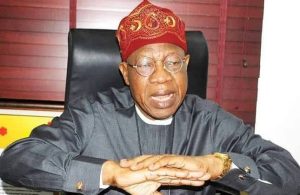
Former Minister of Information and Culture, Alhaji Lai Mohammed, has warned that the increasing use of artificial intelligence (AI) could worsen the spread of fake news and disinformation, threatening Nigeria’s democracy and public trust.
Mohammed cautioned that fabricated audio recordings, manipulated photographs, deepfake videos and forged government documents could be used to mislead voters, manipulate public opinion about political candidates and heighten tensions during elections.
He gave the warning on Wednesday while delivering a public lecture titled, “Fake News, Disinformation and Artificial Intelligence: Defending Truth and Public Trust in the Digital Age,” at Caleb University, Imota, Lagos.
The former minister said his experience in government exposed the extent to which social media platforms could be manipulated to shape public perception, particularly during politically sensitive periods.
He recalled that ahead of the 2023 general elections, his ministry engaged Google, Meta and other social media companies over the growing threat of fake news and misinformation.
He explained that the discussions addressed the use of parody accounts, cloned media platforms, manipulated campaign speeches, altered photographs and videos, fabricated opinion polls, as well as misleading reports of threats and violence.
According to him, such content could distort voters’ understanding of candidates, discourage electoral participation and trigger political tension.
Mohammed said the emergence of AI had made the challenge more complex because fabricated materials could spread widely before fact-checkers and credible media organisations could establish the truth.
“The speed of social media means that by the time a falsehood is debunked, millions of people may already have seen it. That is why the response to disinformation must be built around speed, credibility and verification,” he said.
On the role of government, he urged authorities to take the fight against disinformation seriously without using it as a pretext to restrict legitimate criticism or freedom of expression.
He stressed the need to distinguish between misinformation and unpopular opinions, deliberate deception and honest mistakes, criticism and incitement, as well as satire and malicious fabrication.
Mohammed maintained that democratic governments had a responsibility to provide citizens with accurate, timely and verifiable information rather than demand unquestioning acceptance of official statements.
He also highlighted the importance of professional journalism in tackling disinformation, arguing that the widespread circulation of information on social media had increased the value of credible journalism.
He urged journalists to improve their verification skills, particularly when dealing with photographs, audio recordings and videos, by establishing their original sources, authenticity, dates, locations and context before publication.
“In an environment saturated with synthetic content, verification becomes journalism’s competitive advantage,” he said.
The former minister called on universities to prioritise information literacy and equip students with the skills to critically examine information and distinguish credible reports from fabricated content.
He advised students against accepting or circulating sensational messages shared on WhatsApp and other social media platforms without first establishing their authenticity.
He said citizens should always examine the original source of information, the evidence supporting a claim, whether independent sources could confirm it and whether photographs or videos were presented in their proper context.
Mohammed further advocated the integration of media and information literacy into essential citizenship education, noting that formal education alone did not protect individuals from misinformation.
He explained that citizens also needed to understand how social media algorithms operate and how platforms often promote content capable of generating anger, fear and outrage because of its potential to attract engagement.
“Virality is not evidence of truth. A blue tick is not proof of truth. A professional-looking graphic is not proof of authenticity. A video is no longer automatically conclusive proof,” he said.
He identified the International Media and Information Literacy Institute in Abuja, designated under UNESCO’s Category 2 framework and launched in 2026, as an important opportunity for Nigeria and its partners to strengthen citizens’ capacity to assess media content critically.
However, Mohammed cautioned against treating artificial intelligence as an enemy, describing it as a tool that could be deployed both to create and detect manipulated content.
He noted that AI could help journalists analyse large volumes of information, enable researchers to identify patterns, support fact-checking activities, translate information into different languages and improve government communication.
“The question is therefore not, ‘Should we stop AI?’ We cannot. The better question is, ‘How do we govern, deploy and use AI responsibly?’” he said.
He called for collective action involving technology companies, governments, universities, media organisations and citizens to ensure that artificial intelligence was used responsibly to safeguard public trust and democratic institutions.
Mohammed also emphasised that every Nigerian had a personal responsibility to combat fake news, noting that social media users were active participants in the information ecosystem.
He warned that forwarding unverified messages, circulating manipulated videos and deliberately spreading false information for political, ethnic, religious or personal interests could further undermine public confidence.
He added that individuals who knowingly promote falsehoods to advance the interests of their political parties, ethnic groups or religious communities were contributing to the erosion of public trust.
“When you forward a message, you are not merely passing information to your friends; you are participating in the information ecosystem. When you share a video without checking it, you become part of its distribution chain.
“When you knowingly manufacture a falsehood, you become a producer of disinformation,” he said.
He urged Nigerians to cultivate the habit of verifying information before sharing it, stressing that a brief moment of caution could prevent falsehoods from reaching millions of people.
“The question we should ask ourselves is simple: before I share this, have I verified it? That five-second pause may sometimes prevent five million people from being misled,” he said.