
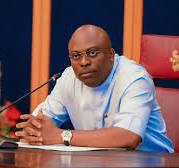
The All Progressives Congress (APC) has explained why Rivers State Governor, Siminalayi Fubara, who recently defected to the party, is yet to be formally received.
Speaking on TVC on Sunday, APC National Chairman, Professor Nentawe Yilwatda, said the delay was a deliberate political strategy aimed at managing regional sensitivities, particularly in northern Nigeria.
Yilwatda explained that the party’s schedule for welcoming defectors prioritised the North due to the approaching Ramadan season.
“We have Kano we are preparing for. In politics, we decided to clear the North first because Ramadan is coming and most people in the North are Muslims,” he said. “There are many communities in the North that are sensitive to Ramadan, so we felt it was important to attend to northern governors first before moving to the South, where Ramadan is not an issue.”
He stressed that the delay had nothing to do with Fubara’s authority or standing within the party.
“These are strategic decisions that recognise the sensitivities of each community. It has nothing to do with Siminalayi Fubara lacking authority,” Yilwatda added.
Responding to claims that Fubara has been unable to assert himself as the APC leader in Rivers State, the APC chairman dismissed the suggestion and challenged critics to provide evidence of any internal complaints.
“I’m the national chairman. Who complained to you? Where is the petition? Give me one petition,” he said. “When nobody has complained and no petition exists, the media should not create one and become the petitioners, the judge, and the jailer at the same time.”
Addressing comments by the Minister of the Federal Capital Territory, Nyesom Wike, about political actors in Rivers State aligning under President Bola Tinubu’s ‘Renewed Hope’ agenda, Yilwatda said such groups were independent of the APC’s official party structures.
“Support groups are separate from party activities. Are they under the office of the party chairman?” he asked.
The controversy surrounding Fubara’s leadership is rooted in the prolonged political crisis in Rivers State. His relationship with his predecessor, Wike, deteriorated following a power struggle after the 2023 elections, a crisis that at one point led President Bola Tinubu to declare a six-month state of emergency in the state.
Fubara officially defected from the Peoples Democratic Party (PDP) to the APC on December 9, 2025—a move widely viewed as part of his strategy to secure a second term in 2027 and consolidate political support after his fallout with Wike.
However, Wike, who remains a dominant political force in Rivers State despite not being an APC member, has disputed claims that Fubara’s defection automatically makes him the party’s leader in the state. He has argued that leadership is determined by control of party structures and grassroots support, which his allies continue to hold in some areas.
This dynamic has intensified political tensions in the state, with rival factions within both the APC and PDP engaging in impeachment threats, negotiations, and manoeuvres aimed at stabilising the political landscape ahead of the 2027 elections.