
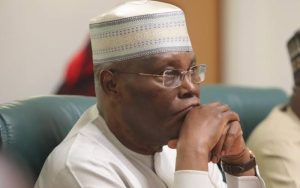
Former Vice President and African Democratic Congress (ADC) presidential candidate, Atiku Abubakar, has accused President Bola Tinubu of worsening Nigeria’s cost-of-living crisis, blaming the administration’s economic policies for eroding household purchasing power and increasing pressure on businesses.
Atiku made the allegation in a statement issued on Sunday in Abuja by his Senior Special Assistant on Public Communication, Phrank Shaibu.
He said Nigerians were grappling with rising prices of fuel, food, transportation and other essential commodities despite claims by the Federal Government that key economic indicators were improving.
The former vice president also criticised the Tinubu administration’s opposition to his proposed Production Subsidy, arguing that targeted support for domestic production and refining would increase supply, reduce prices and put more money in the hands of Nigerians.
Atiku cited the position of the Crude Oil Refinery Owners Association of Nigeria (CORAN) in support of domestic refining, as well as the United States’ efforts to strengthen its petroleum production and refining capacity, as evidence that strategic government intervention could be justified in critical sectors.
“Tinubu did not inherit this cost-of-living crisis from Nigerians. His policies created and deepened it. He took away relief from the people, made fuel, food, transport and basic survival more expensive, and now wants Nigerians to applaud statistics while their pockets are empty,” he said.
Businesses Also Under Pressure
Atiku said the economic hardship was also affecting businesses as declining consumer purchasing power made it increasingly difficult for traders and companies to sell their goods and services.
He referred to reports indicating that significant portions of the short-term assets of some major Nigerian companies were tied up in unpaid customer bills, which he said reflected the financial strain on consumers.
He illustrated the situation with the example of a frozen-food trader in Kubwa, Abuja, who, according to him, is facing increased transportation, electricity and restocking costs while customers are buying less or asking to purchase on credit.
Atiku warned that such pressures could spread across the supply chain, affecting retailers, suppliers and other businesses.
He further pointed to increases in the prices of fertiliser, petrol and cement, alongside exchange-rate movements, as indicators of the rising cost of living.
“Nigerians know the prices they meet every day. Fertiliser has moved from about ₦9,000 to around ₦50,000; petrol from about ₦199 to around ₦1,400 per litre; cement from roughly ₦4,000 to around ₦13,500; and the dollar from around ₦450 to about ₦1,400,” Atiku said.
‘What Exactly Are Tinubu’s Defenders Defending?’
The ADC presidential candidate questioned what he described as the limited benefits ordinary Nigerians had received amid the economic difficulties.
“No reliable electricity. Loan for a degree. No security. No N-Power. Food is expensive. Transport is expensive. Life itself has become expensive. What exactly are Tinubu’s defenders defending?” he asked.
Atiku maintained that his Production Subsidy proposal was designed to boost local production, increase supply and lower the prices of essential goods.
“This is why my Production Subsidy is about putting money back into people’s pockets. Support what we produce and refine here, increase supply, monitor the price and make sure Nigerians feel the benefit at the pump,” he said.
Atiku Faults Government’s Economic Priorities
The former vice president also accused the Federal Government of applying different standards to interventions designed to benefit ordinary Nigerians and incentives granted to major businesses and multinational oil companies.
“CORAN is saying support domestic production. America understands the importance of supporting strategic energy production. Yet Tinubu attacks relief for ordinary Nigerians while his government understands perfectly well how to grant waivers, incentives and concessions to multinational oil companies and businesses close to his administration,” he alleged.
Atiku questioned why government intervention should be regarded as poor economic policy when ordinary Nigerians are the intended beneficiaries.
“So why does intervention suddenly become bad economics when ordinary Nigerians are meant to benefit?” he asked.
He said Nigerians were more interested in the practical effects of government policies on their daily lives than official economic statistics.
Atiku called for measures that would increase domestic production, strengthen local refining, create jobs and reduce the cost of living.
“The choice before Nigeria is therefore clear: continue with an economy that takes more from the people, or build one that puts money back in their pockets. Support production. Refine in Nigeria. Create Nigerian jobs. Lower the cost of living,” he said.
He urged Nigerians to support economic policies capable of making essential goods and services more affordable, insisting that household welfare should remain at the centre of economic policymaking.
“Nigeria must produce more, Nigerians must pay less, and families must have money left to live,” Atiku said.
He concluded with a campaign message: “Tinubu made life expensive. Atiku will make life affordable again.”

