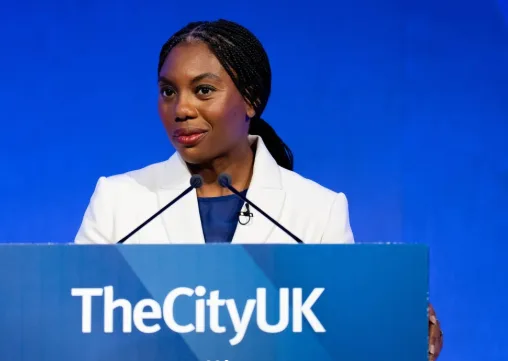
Conservative Party leader Kemi Badenoch has declared that the Falkland Islands are “British” and accused Argentina of using football as a platform for political messaging after members of the national team displayed a banner asserting Argentina’s claim to the disputed territory following their World Cup semi-final victory over England.
Her comments came as FIFA confirmed that its independent disciplinary committee was reviewing reports from the match and the circumstances surrounding the banner display to determine whether any regulations prohibiting political messages were breached.
The UK government also backed calls for an investigation, insisting that the status of the Falkland Islands is not open to debate.
A Downing Street spokesperson remarked that while England may have missed out on the World Cup final, “the Falkland Islands definitely are” British. Business Minister Peter Kyle also condemned the banner, describing it as “an egregious violation” of FIFA regulations and stressing that politics should remain separate from football.
In a video posted on X on Friday, Badenoch reiterated her support for the British territory and urged FIFA to examine the incident.
“The Falkland Islands are British. The Conservatives will always defend them,” she said.
“We know that political messaging and slogans are banned by FIFA, so they absolutely should investigate. It was a very silly banner.
“The fact is that the Falkland Islands are British, and the Conservatives will never stop defending them. We did it before, and we would do it again.”
The controversy erupted after Argentina’s players unveiled a banner reading “Las Malvinas son Argentinas” (“The Falklands are Argentine”) following their 2-1 win over England in Atlanta.
The Falkland Islands, a British Overseas Territory in the South Atlantic, have long been the subject of competing sovereignty claims by Britain and Argentina. The dispute led to the 1982 Falklands War, a 74-day conflict that claimed the lives of 649 Argentines, 255 British military personnel and three island residents.
Previous FIFA Sanction
FIFA has dealt with a similar incident involving Argentina in the past.
In 2014, the Argentine Football Association was fined after the national team displayed the same “Las Malvinas son Argentinas” banner before an international friendly against Slovenia. FIFA ruled that the act violated its regulations regarding political messages and team conduct.
Badenoch Targets Labour Over Chagos Deal
Badenoch also used the controversy to criticise the Labour government’s handling of the Chagos Islands, arguing that the Conservatives would never take a similar approach with the Falklands.
“Unlike Labour, who gave away British territory in the Chagos Islands, we will never do that,” she said.
“That match was a great game to watch, but also very painful. I have a nine-year-old who was devastated by the result after England led for so long and then lost at the end.
“Winning a football match does not mean you can have the Falklands, so hands off.”
Her remarks referred to the UK’s agreement to transfer legal sovereignty over the Chagos Archipelago to Mauritius while maintaining British and American military access to Diego Garcia under a long-term lease arrangement.
The agreement, first announced in principle in 2024, followed years of legal and diplomatic pressure on Britain regarding its administration of the islands.
Critics, including Badenoch, view the deal as a surrender of British territory, while supporters argue it protects strategic security interests by preserving the Diego Garcia military base while resolving a longstanding sovereignty dispute.
Argentina Awaits FIFA Decision
Argentina is now awaiting FIFA’s decision on whether disciplinary action will be taken over the banner display.
President Javier Milei defended the action, describing it as “perfectly valid and legitimate.”
“It’s a feeling shared by all Argentines,” Milei told El Observador radio.
“The Malvinas are Argentine, we are going to recover them, and we will do so through diplomatic means.”
Vice President Victoria Villarruel further heightened tensions before the semi-final by referring to the English as “usurping pirates.”
Following the match, Argentina’s Foreign Minister, Pablo Quirno, announced that Buenos Aires had lodged a formal protest over the presence of a British warship near the Falkland Islands.
Writing on X, Quirno expressed Argentina’s “strongest rejection” of what he described as the “unconsulted and illegal” passage of HMS Medway through Argentine territorial waters.