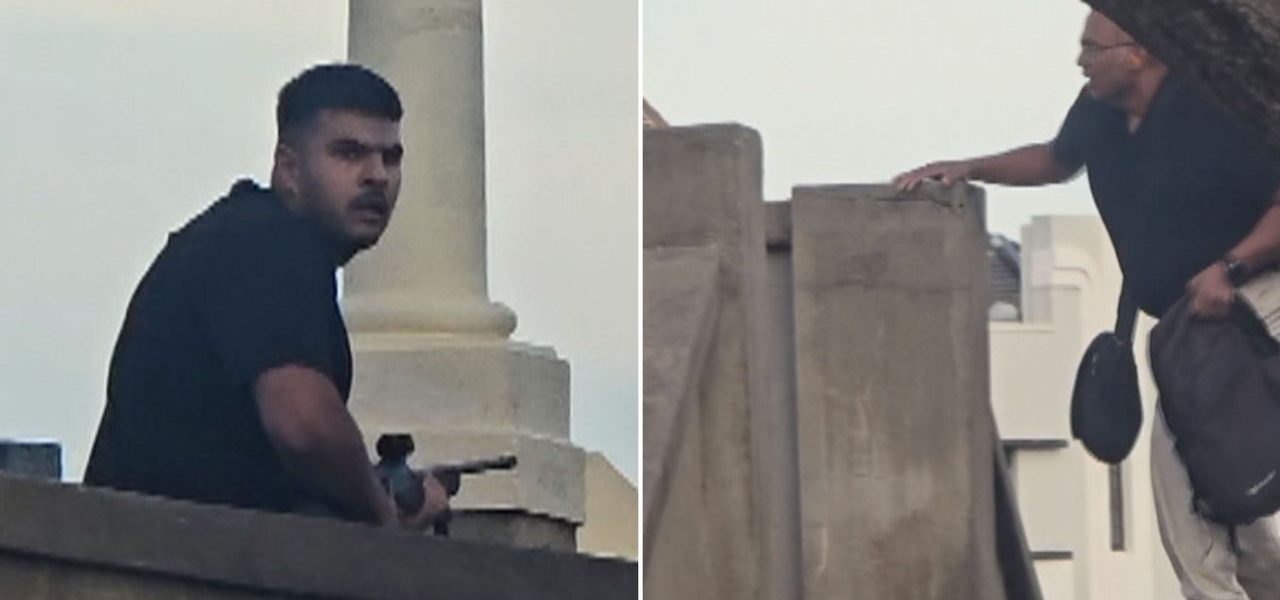
Australian authorities say the father and son accused of carrying out the deadly Bondi Beach attack were motivated by Islamic State ideology and had recently travelled to a known extremist stronghold in the Philippines.
The suspects have been identified as 50-year-old Sajid Akram, who was killed during a police confrontation, and his 24-year-old son, Naveed Akram, who remains in critical but stable condition in hospital under heavy police guard.
The attack occurred on Sunday evening during a “Chanukah by the Sea” celebration at Bondi Beach, leaving 15 people dead, including a 10-year-old girl, Matilda, two rabbis and an 87-year-old Holocaust survivor, Alex Kleytman. It is Australia’s deadliest mass shooting in nearly three decades.
Witnesses described scenes of chaos as gunfire erupted from a pedestrian bridge near Campbell Parade, sending families and tourists fleeing for safety. Authorities have credited a civilian bystander, identified as Ahmed, with tackling and disarming one of the attackers, allowing police time to intervene.
Investigators are now focusing on a nearly month-long trip the pair took to the Philippines in November 2025. Immigration records show the men travelled together to Mindanao, a southern island long associated with Islamist insurgent groups, including Abu Sayyaf and Islamic State East Asia.
Australian counterterrorism officials believe the suspects may have undergone military-style training during their stay. This assessment is supported by video footage from the attack, which appears to show Naveed Akram handling a bolt-action rifle with a high level of proficiency.
Prime Minister Anthony Albanese described the shooting as a “radical perversion of Islam” and an act of “pure evil.” Investigators have recovered two homemade ISIS flags and improvised explosive devices from a vehicle linked to the younger suspect. Authorities currently believe the pair acted as a self-contained cell rather than as part of a broader network.
Security agencies are also reviewing why the suspects evaded detection, despite Naveed Akram having been investigated by the Australian Security Intelligence Organisation (ASIO) for six months in 2019. That investigation concluded there was no immediate threat at the time.
The case has raised further questions about gun licensing, as Sajid Akram was a licensed firearm owner who legally possessed six guns, including those used in the attack. Sajid, who migrated to Australia in 1998, operated a fruit shop in Sydney’s southwest and was a member of a local hunting club.
In response, Prime Minister Albanese has pledged a comprehensive review of Australia’s gun laws, stressing that firearm licences should not be granted indefinitely given the potential for rapid radicalisation.
As investigations continue and Naveed Akram awaits formal charges, Bondi Beach has become a place of mourning, with thousands gathering to honour the victims of what authorities have described as a calculated act of antisemitic terrorism.