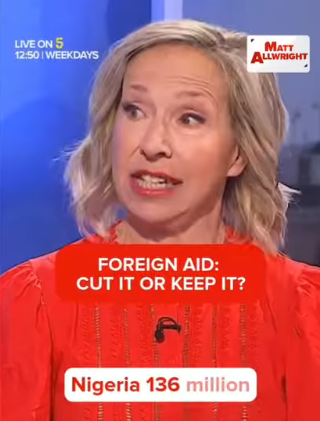
British journalist Lowri Turner has called on the United Kingdom government to reduce foreign aid to Nigeria, questioning the accountability of funds allocated to the country.
In a video that has gone viral, Turner made the remarks while speaking on a Channel 5 programme in the UK, arguing that millions of pounds in aid often fail to reach the ordinary people who need assistance because of alleged high-level corruption.
She cited the £136 million reportedly provided to Nigeria annually, alongside claims that the country loses more than $15 billion to corruption each year.
Turner argued that Nigeria’s significant number of wealthy individuals raised questions about why the country should continue receiving foreign aid without adequate accountability for how the funds are spent.
She also highlighted the economic difficulties facing people in the UK, noting that many hardworking British citizens struggle to pay their energy bills and afford food.
According to her, the British government should prioritise the welfare of its citizens before committing millions of pounds to aid programmes abroad.
“We currently give Nigeria £136 million a year. They have eight and a half thousand millionaires there, and they lose approximately $15 billion a year in corruption. So, we are giving money to a country that has a great number of wealthy people in it and this money will be fuelling the corruption, so I don’t think we should be giving them aid,” she said.
Turner further argued that foreign aid could contribute to corruption in some countries and undermine their efforts to develop independent economies.
“There is no doubt aid funnels corruption in certain countries. It also infantilises them. If you ask some people in African countries, they say, ‘We don’t want white saviour complex.’ We want to be able to build our own economies,” she added.
The journalist also questioned why Nigeria should continue to depend on assistance from foreign governments despite having a substantial population of millionaires.
Her comments have sparked debate online, with discussions focusing on foreign aid, corruption, accountability and the responsibility of governments to prioritise their citizens’ welfare.
Watch the video of her remarks below.