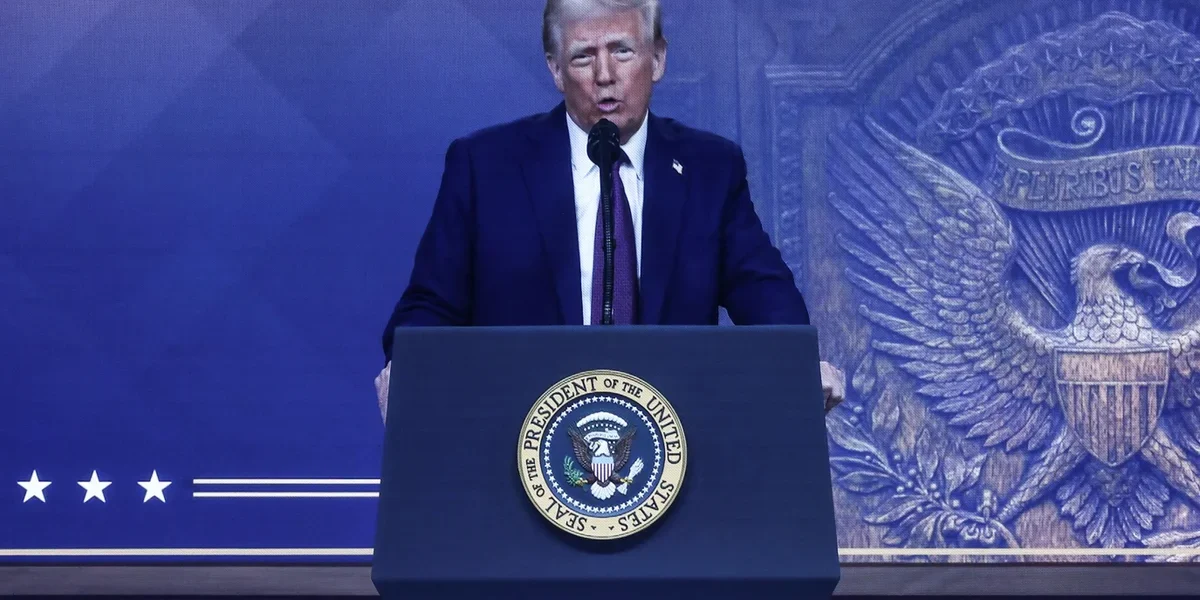
Canadian Prime Minister Mark Carney on Thursday pushed back against a provocative remark by U.S. President Donald Trump, who claimed at the World Economic Forum that “Canada lives because of the United States.”
“Canada doesn’t live because of the United States. Canada thrives because we are Canadian,” Carney said in a nationally televised address from Quebec City ahead of the opening of a new legislative session. He nevertheless acknowledged the “remarkable partnership” between the two neighbouring countries.
Trump appeared to respond later the same day on his Truth Social platform, announcing that he was withdrawing an invitation for Canada to join his proposed “Board of Peace,” a self-styled billion-dollar initiative aimed at resolving global conflicts.
A Canadian government source told AFP on Monday that Canada would not pay to join the board, although Carney had previously indicated he would consider participating if invited.
The exchange highlights rising tensions between the long-standing allies.
Carney’s address followed his widely publicised speech earlier this week at the World Economic Forum in Davos, Switzerland, where he received a standing ovation for his blunt assessment of a “rupture” in the U.S.-led, rules-based global order. Although Trump was not mentioned by name, the comments were widely interpreted as a critique of the former president’s disruptive approach to global affairs.
In Davos, Carney warned that middle powers such as Canada, which had benefited under an era of American dominance, must recognise that global dynamics have shifted and that “compliance” would no longer protect them from aggression by major powers.
Trump took offence and mocked Carney during his own remarks at the forum a day later.
“I watched your prime minister yesterday. He wasn’t so grateful,” Trump said on Wednesday.
“Canada lives because of the United States. Remember that, Mark, the next time you make your statements.”
Addressing Canadians on Thursday, Carney said the country should position itself as a model at a time of global “democratic decline.”
“Canada can’t solve all the world’s problems, but we can show that another way is possible — that the arc of history isn’t destined to bend toward authoritarianism and exclusion,” he said.
Despite his criticism of Trump since the latter’s return to office nine months ago, Carney leads a country that remains deeply dependent on trade with the United States, which receives more than three-quarters of Canadian exports.
Key sectors such as automobiles, aluminum and steel have been hit by Trump’s global tariffs, though the impact has been softened by his administration’s continued adherence to the existing North American free trade agreement. Talks to revise the deal are expected to begin early this year.
Trump has repeatedly argued that the United States does not need Canadian products — a stance that could have severe consequences for Canada’s economy. He has also repeatedly threatened to annex Canada and recently shared a social media image depicting Canada, along with Greenland and Venezuela, draped in the American flag.
Carney said on Thursday that Canada harbours no illusions about the fragile state of global affairs.
“The world is more divided. Former alliances are being redefined and, in some cases, broken,” he said.
Referencing plans to increase defence spending, Carney added that Canada “must defend our sovereignty and secure our borders,” stressing that the country has a responsibility “to be a beacon — an example to a world that’s adrift.”