
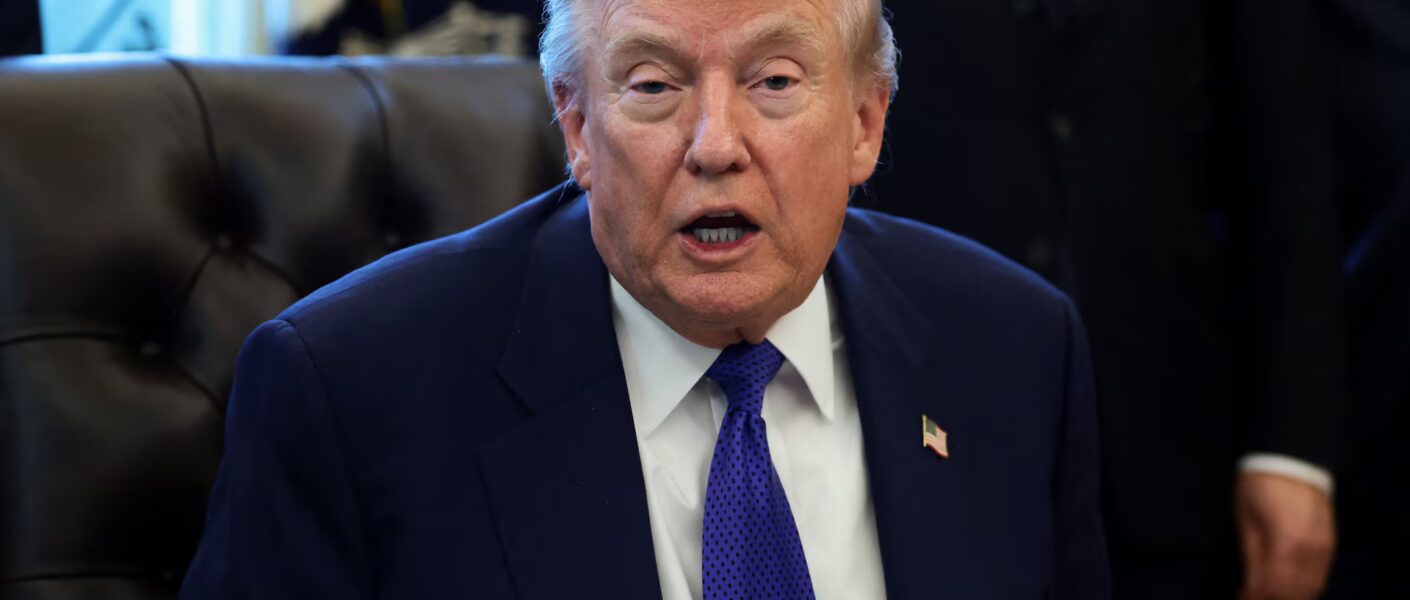
U.S. President Donald Trump has claimed that Iran’s next supreme leader may find it difficult to remain in power without approval from Washington, as Tehran prepares to announce a successor to the late Ali Khamenei.
The remarks come nine days after joint U.S.–Israeli strikes reportedly killed Khamenei, an event that has intensified conflict across the Middle East. Following his death, Iran’s Assembly of Experts reportedly held a closed-door meeting and selected a new supreme leader.
Although the clerics have yet to reveal the identity of the chosen successor, they indicated that an official announcement would be made soon. Some insiders have suggested that Khamenei’s 56-year-old son, Mojtaba Khamenei, could be the next leader.
Trump previously dismissed the possibility of Mojtaba assuming the role, describing him as an unacceptable “lightweight.”
“He’s going to have to get approval from us,” Trump said during an interview with ABC News, referring to Iran’s next leader. “If he doesn’t get approval from us, he’s not going to last long.”
Iranian officials quickly rejected the comments. Iran’s Foreign Minister Abbas Araghchi insisted that the selection of the country’s supreme leader is strictly an internal matter and warned against foreign interference.
Speaking during an interview on Meet the Press, Araghchi stressed that Iran would not allow outside powers to influence its leadership decisions. He also called on Trump to apologise to the region for escalating tensions.
Mojtaba Khamenei is widely viewed as a conservative figure within Iran’s political establishment, partly because of his close ties to the Islamic Revolutionary Guard Corps.
Meanwhile, the conflict between Iran and Israel has continued to intensify. Israel has warned that any successor to Khamenei could become a potential target if hostilities continue.
Overnight air strikes targeted fuel storage facilities around Tehran, while another strike reportedly hit a hotel in Beirut believed to be hosting suspected Iranian commanders.
Warplanes struck five oil facilities near the Iranian capital, killing at least four people and sending thick smoke across the city, according to a state oil official. Tehran’s governor said fuel distribution in the capital was temporarily disrupted, while residents reported a dark haze covering the city of roughly 10 million people.
Authorities warned that fumes from the fires could be toxic and advised residents to remain indoors as the smell of burning fuel spread through parts of the city.
One resident said the fires had been burning for more than 12 hours, making the air difficult to breathe and forcing many people to stay inside their homes.
As the war entered its ninth day, the Islamic Revolutionary Guard Corps claimed Iran has enough supplies to continue drone and missile attacks across the region for up to six months.
Explosions were also heard over Tel Aviv after Israeli defence systems detected a new wave of Iranian missiles. Emergency services reported that at least six people were injured in central Israel.
Trump also declined to rule out the deployment of U.S. ground troops in Iran, though he insisted the war was close to being won despite ongoing missile and drone attacks.
The U.S. president later held a phone conversation with British Prime Minister Keir Starmer to discuss military cooperation. Britain has allowed the United States to use its bases for what officials described as collective self-defence operations in the region.
An Iranian military spokesman said the country has so far used only first- and second-generation missiles but warned that more advanced long-range weapons could be deployed in the coming days as the conflict continues to escalate.