
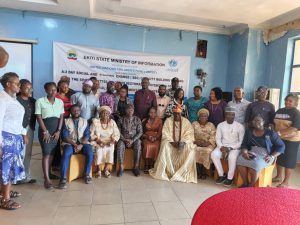
The Ekiti State Government has reiterated its commitment to sustained collaboration with development partners and NGOs to enhance the welfare of residents—especially children.
Special Adviser to the Governor on Information, Taiwo Olatunbosun, made this known in Ado Ekiti during a two-day Social and Behavioural Change (SBC) Capacity Building Meeting for the state’s SBC Committee, organised by the Ministry of Information in partnership with UNICEF.
Stakeholders, including health workers, WASH specialists, educators, religious leaders, market leaders, and civil society groups, underscored the need for stronger sensitisation and better health practices to address barriers to vaccine uptake. They urged religious organisations and parents to play active roles in preventing avoidable child deaths.
Olatunbosun praised UNICEF’s consistent support and reaffirmed the Oyebanji administration’s commitment to child-focused initiatives.
He said, “Today’s meeting reaffirms our resolve to strengthen interventions that improve community well-being. Social and behavioural change drives healthy practices and ensures our programmes deliver measurable results.”
He encouraged SBC committee members to extend their training to communities and ensure interventions remain people-centred, data-driven, and sustainable.
UNICEF Director of Programmes, Mrs Adeola Fadiran, highlighted the importance of cross-sectoral collaboration, noting that behaviour is influenced by multiple systems—health, education, culture, environment, and community leadership.
She said unified, evidence-driven efforts were essential for improving vaccine uptake, child nutrition, sanitation, and safety.
Fadiran commended Governor Biodun Oyebanji for his dedication to child welfare and urged SBC members to be “agents of change” committed to long-term community engagement and sustainable behaviour change.
Also speaking, the Iyalaje of Okesa Market, Mrs Olayinka Babalola, applauded the government and UNICEF for the impactful programme and encouraged parents to ensure their children receive all necessary vaccinations.
The development comes as the Federal Ministry of Health advances the Nigerian Child Survival Action Plan, aiming to reduce under-five mortality to fewer than 25 deaths per 1,000 live births by 2030 through a multisectoral strategy integrating health, education, nutrition, and child protection.