
The Federal Government has identified improved access to capital for women-led businesses as a key driver for Nigeria’s industrial growth and a strategic way to maximise opportunities under the African Continental Free Trade Area (AfCFTA).
This was disclosed by the Minister of Industry, Trade and Investment, Jumoke Oduwole, during a high-level policy dialogue organised to mark International Women’s Day in Abuja.
According to the minister, women-owned businesses across Africa face a financing gap estimated at more than $49 billion, a challenge that continues to limit their ability to expand and compete across the continent.
The event, themed “Give to Gain,” brought together policymakers, investors, development partners and private sector leaders to discuss how expanding financial support for women entrepreneurs could strengthen Nigeria’s participation in Africa’s growing trade market.
Speaking at the dialogue, Oduwole stressed that Nigeria’s ambition to build a $1 trillion economy by 2030 cannot be achieved without fully harnessing the potential of women-led enterprises.
She noted that women already play significant roles in sectors such as agriculture, trade, services, manufacturing and logistics, but remain constrained by limited access to capital.
“The constraint is not participation, it is capital—how it is structured and how it is allocated,” she said, noting that female-founded companies received less than 10 percent of venture and growth capital deployed across Africa last year.
The minister explained that the AfCFTA creates a massive integrated market linking over 1.4 billion people with a combined GDP of about $3.4 trillion, making it one of the largest trade zones globally.
However, she pointed out that only a small number of African firms have reached global scale.
“Across Africa, there are only about 345 companies generating more than $1 billion in annual revenue, and roughly 20 of them are in Nigeria,” Oduwole said, adding that unlocking women’s entrepreneurial capacity is essential to expanding this number.
She further revealed that African governments are introducing new trade frameworks aimed at improving opportunities for women and young entrepreneurs.
These include the Protocol on Women and Youth in Trade and the Protocol on Digital Trade under the AfCFTA, which are designed to expand access to markets, finance and digital trade opportunities.
Oduwole said Nigeria has already begun domesticating these frameworks through programmes aimed at preparing women-owned businesses to access capital and participate in international trade.
She disclosed that the initiative was partly inspired by discussions with the Minister of Women Affairs, Imaan Sulaiman-Ibrahim, on strengthening financial support for female entrepreneurs.
According to the minister, Nigeria’s ongoing economic reforms are already attracting investment and boosting trade.
She revealed that the country recorded $21 billion in capital importation within the first 10 months of 2025, while non-oil exports exceeded $6.1 billion during the same period.
Oduwole also highlighted key trade partnerships aimed at expanding Nigeria’s global market presence, including the U.S.-Nigeria Commercial and Investment Partnership, the U.K.-Nigeria Enhanced Trade and Investment Partnership, and the Comprehensive Economic Partnership Agreement with the United Arab Emirates.
“These reforms are laying the foundation for capital to flow and for trade to thrive,” she said, adding that the government is focused on connecting global demand with Nigeria’s supply capacity.
She also noted that Nigeria will actively participate in shaping Africa’s trade agenda ahead of the 14th Ministerial Conference of the World Trade Organisation scheduled to hold in Yaoundé, Cameroon.
In her remarks, the Minister of Women Affairs, Imaan Sulaiman-Ibrahim, emphasised the importance of integrating gender-responsive policies into national trade frameworks to fully harness AfCFTA opportunities.
She called for simplified business registration processes, improved documentation systems and inclusive trade procedures that allow women entrepreneurs to formalise and expand their businesses.
“Empowering women economically is not only a matter of fairness; it is a strategic investment in Nigeria’s prosperity,” she said.
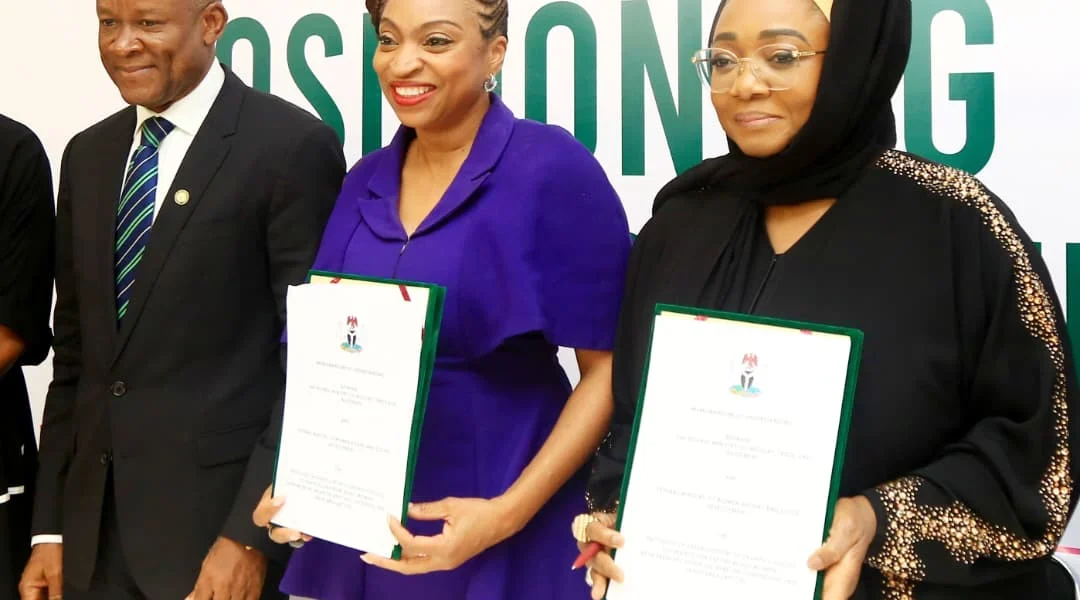
The minister also announced the signing of a Memorandum of Understanding between the Federal Ministry of Women Affairs and the Federal Ministry of Industry, Trade and Investment to improve access to finance for export-ready women entrepreneurs.
The partnership will support initiatives such as export readiness training, digital trade capacity development and the creation of a national database of women-owned enterprises.
Also speaking at the event, the Head of the Civil Service of the Federation, Didi Esther Walson-Jack, praised the initiative, noting that women remain central to innovation, entrepreneurship and enterprise development across Africa.
She said their full participation would be crucial to the success of AfCFTA and Nigeria’s broader economic transformation.
The policy dialogue concluded with renewed commitments from policymakers, investors and development partners to translate the discussions into concrete programmes and partnerships that will expand market access, accelerate industrialization and empower Nigerian women-led businesses to thrive within the AfCFTA framework.