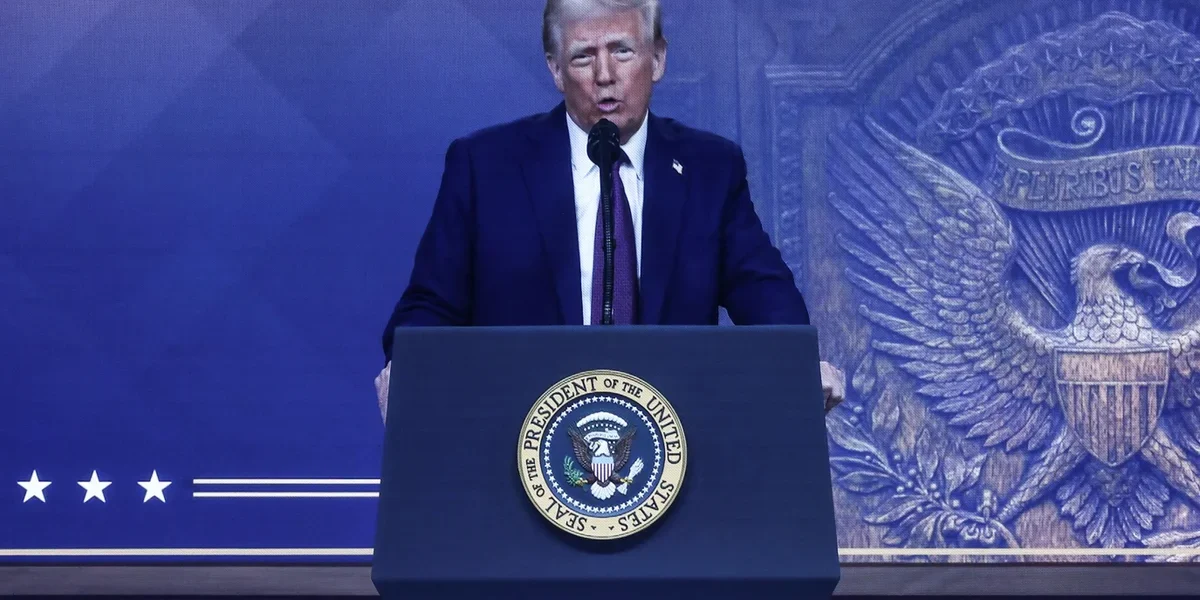
Greenland and Denmark have temporarily set aside their complex history to present a united front against US President Donald Trump. The Arctic island, a Danish colony for three centuries, remains an autonomous territory under Denmark, but its political landscape is dominated by the question of independence.
While all major Greenlandic parties support independence, they differ on how to achieve it. Trump’s interest in acquiring the island prompted the parties to form a coalition government in March 2025, putting long-term independence plans on hold.
“Greenlanders still have a lot of grievances concerning Denmark’s failure to fully reckon with its colonial past,” said Ulrik Pram Gad, a researcher at the Danish Institute for International Studies (DIIS). “But Trump’s pressure has led the majority of the political spectrum in Greenland to temporarily shelve independence preparations. European support has also made this easier, making the relationship with Denmark feel less claustrophobic.”
The coalition, formed amid growing US pressure, included all main parties except Naleraq, which advocates a fast track to independence. At the peak of the crisis, Greenland’s Prime Minister Jens-Frederik Nielsen emphasized that the island would choose Denmark over the United States if forced to make a choice.
Diplomatic Moves
Trump’s push for a framework deal, discussed with NATO chief Mark Rutte, reinforced Greenland and Denmark’s insistence that decisions about the island must be made internally. In recent weeks, the two governments have spoken with a single voice:
- On January 14, Greenland’s Foreign Minister Vivian Motzfeldt met with US Vice President JD Vance and Secretary of State Marco Rubio in Washington alongside her Danish counterpart, Lars Lokke Rasmussen.
- By Monday, she was in Brussels for talks with Rutte and Denmark’s Defence Minister Troels Lund Poulsen.
Despite this unity, the scars of Greenland’s colonial past remain deep.
Colonial Legacy
Greenland was a Danish colony from the early 18th century, became fully part of Denmark in 1953, and gained autonomous status in 1979—a status strengthened in 2009. Astrid Andersen, a specialist in Danish-Greenlandic relations at DIIS, notes: “Any colonial relationship involves domination, and there have been injustices committed.”
Among these were a 1951 social experiment in which 22 Inuit children were forcibly removed from their families and prevented from speaking Greenlandic. In 2021, the six survivors received compensation of 250,000 crowns (approximately €33,500) each.
From the 1960s onward, Denmark also implemented policies to reduce Greenland’s birth rate. Thousands of women and teenage girls—at least 4,000—were fitted with IUDs without consent. Nearly half of them were unable to have children later. Prime Minister Mette Frederiksen has apologized, and a compensation program is underway.
Denmark’s social services additionally used psychological tests to assess whether Greenlandic mothers were fit to parent—a practice that was discontinued only last year. A 2022 study showed that children born to Greenlandic families in Denmark were five to seven times more likely to be placed in care than children born to Danish families.
Unity Amid Tension
Despite these historical injustices, the immediate threat posed by Trump’s interest in Greenland has temporarily pushed these debates to the background. Andersen observed: “Right now, there’s broad agreement—except for a few exceptions—that the common opponent is Trump, and Greenland and Denmark need to face this together.”