
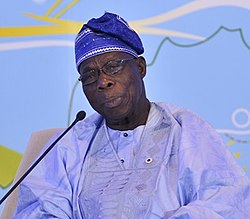
Former President Chief Olusegun Obasanjo has declared that at 89 years old, he has no intention of dying anytime soon. He condemned those circulating a fake letter falsely claiming he was speaking about his death, dismissing them with the words: “I dey kampe.”
Obasanjo made the remarks on Wednesday during a colloquium titled “Burden and Blessing of Leadership: Reflections from Global Africa to the World”, held in Abeokuta as part of celebrations marking his 89th birthday. Born on March 6, 1937, Obasanjo said he remained reasonably healthy and credited God for keeping him alive.
Addressing those wishing him dead, he said:
“They publish and circulate a fake paper claiming I’m giving notice of my death. That is their wish, not God’s. God has assured me He has more for me to do on earth, and He has given me the strength to do it. And those who wish otherwise will be dealt with by God Himself. I dey kampe as usual.”
Earlier in his address, Obasanjo lamented the leadership crisis that has long hindered Africa’s development and economic prosperity.
“Africa is not a problem to be managed but a promise to be fulfilled through honest, courageous, selfless, incorruptible, and transformational leadership,” he said.
He cited his own incarceration and near execution under the military regime of the late Gen. Sani Abacha as examples of the burdens of leadership.
Highlighting Africa’s unrealized potential, Obasanjo stated:
“By every measure of natural endowment, Africa should be a continent of prosperity, stability, peace, security, and global influence. Yet, much of the continent remains a theatre of preventable disease, conflict, insecurity, poverty, and suffering.”
He identified leadership failure, not geography or history, as the main cause, saying:
“The primary cause is the failure of those entrusted with power to lead for the people, build institutions rather than subvert them, welcome accountability rather than evade it, and ensure equity and justice rather than perpetuate inequality and corruption.”
Obasanjo warned that many leaders arrive with promises but soon govern for personal or familial gain, undermining democracy and eroding institutions:
“The same young reformer who promised accountability begins to silence the press, harass the judiciary, and intimidate civil society. All institutions become perverted to serve the interests of the leader, his family, political allies, and business interests.”
To address Africa’s leadership gap, he stressed the importance of leadership formation, not just training:
“We must invest in forming leaders who are imbued with the values and attributes to do the job the right way, not just teach them what to do.”
He urged young Africans to take democracy seriously and commit to governance that is accountable, transformational, transparent, and focused on the common good:
“A continent that fails its youth does not merely waste a generation; it plants seeds of instability that will haunt future generations.”
Reflecting on his personal leadership experiences, Obasanjo spoke of the loneliness and moral weight of decision-making—from commanding troops in the Nigerian Civil War to serving as Nigeria’s President from 1999 to 2007.
“The loneliness I speak of is the loneliness of final decision… your decision affects millions of lives. That weight settles on one pair of shoulders—the leader’s shoulders,” he said.
Recalling the end of the Civil War, he said:
“In January 1970, my troops were poised for the final push. Hundreds of thousands of Igbo civilians were trapped, starving, dying. I had to weigh ending the war quickly against worsening the humanitarian crisis. No textbook told me what to do. No senior officer would make the call. It was mine alone. We saved lives by not shelling Owerri. History has rendered its verdict.”
He also highlighted the burden of being the repository of people’s hopes and the pressure of principle:
“True leadership requires holding a position when unpopular, saying no when yes is easier, and naming truths powerful interests wish suppressed. It costs friendships, alliances, and sometimes freedom—as I learned during my three-and-a-half-year imprisonment under Abacha.”
Yet, leadership carries blessings. Obasanjo cited achievements such as Paris Club debt relief and the creation of the Economic and Financial Crimes Commission to recover stolen public funds:
“The blessing of doing the right thing, even when the wrong thing is easier, is the opportunity for moral self-definition.”
On his personal well-being, Obasanjo affirmed he remains strong and healthy at 89, once again dismissing rumours of his death:
“God has assured me He has more for me to do on earth, and He has given me the strength to do it. I dey kampe as usual.”
