Iran has buried former Supreme Leader Ali Khamenei more than four months after he was killed in an airstrike, as renewed military exchanges between Tehran and Washington fuel fears of another major escalation in the region.
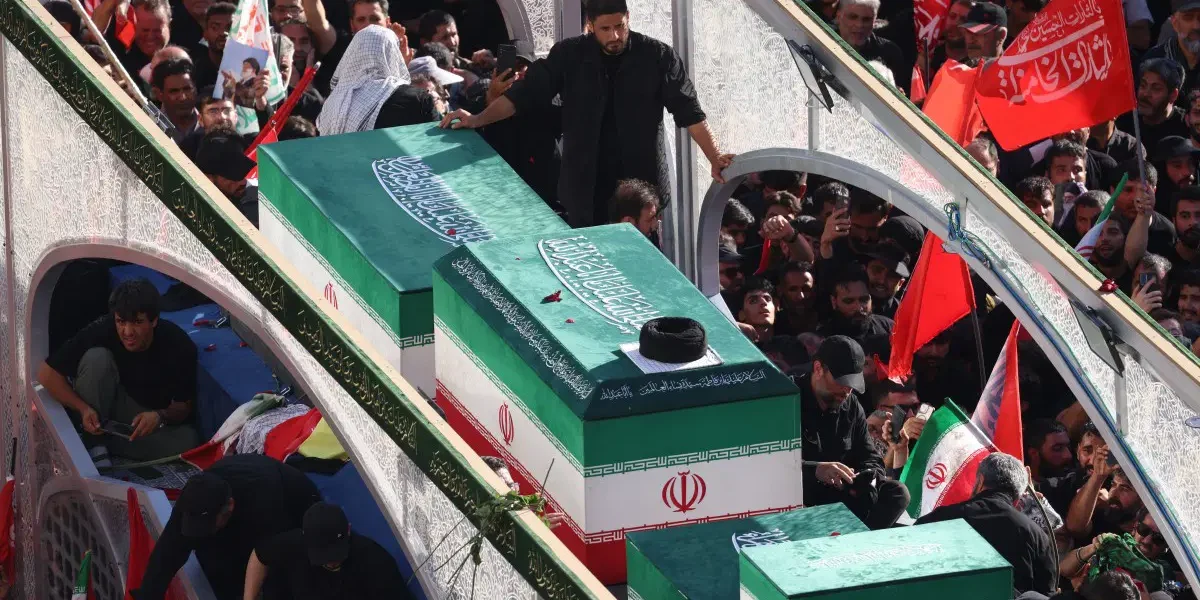
Khamenei’s flag-draped coffin was carried into the Imam Reza Shrine in his hometown of Mashhad, eastern Iran, where large crowds gathered for the final funeral rites. However, his successor and son, Mojtaba Khamenei, was not seen at the ceremony.
“The body of the martyred leader of the Islamic Revolution was buried in the memorial hall of the shrine of Imam Reza,” Iran’s state broadcaster IRIB reported.
The burial marked the end of a six-day funeral programme and took place as the United States and Iran exchanged further attacks, raising concerns that tensions could spiral back into a wider conflict.
Iranian officials said US strikes killed 17 people, while state media reported that one attack targeted a railway line connecting Tehran and Mashhad. Tehran also claimed to have launched fresh attacks against US military assets in Kuwait, Bahrain and Qatar.
In Jordan, another US ally, authorities said they intercepted eight missiles fired from Iran.
Khamenei was killed alongside members of his family during the opening day of the US-Israeli war against Iran on February 28.
Several senior Iranian officials attended the burial, including parliament speaker Mohammad Bagher Ghalibaf, Chief Justice Gholamhossein Mohseni Ejei and Khamenei’s eldest son Mostafa Khamenei. State television footage showed some officials mourning over the coffin.
However, Mojtaba Khamenei, who was named as his father’s successor, was absent once again. Since his appointment, he has only issued statements through written messages and is reportedly believed to have been injured in the February 28 strikes.
Thousands of mourners dressed in black gathered in Mashhad, with some chanting against US President Donald Trump and calling for retaliation. Slogans directed at Trump were displayed in English during the funeral.
Meanwhile, The Wall Street Journal reported that Israel had shared intelligence with the United States about an alleged Iranian plot targeting Trump, citing unnamed sources.
Iranian state media also reported that US forces struck near the country’s only civilian nuclear facility in Bushehr province, although a US defence official said American forces were not conducting strikes in Iran at the time.
Iran’s military claimed it had targeted a Patriot missile system in Kuwait, an early warning facility in Qatar and fuel storage sites in Bahrain using drones. However, US officials said dozens of Iranian missiles and drones were either intercepted or caused no significant damage, with no American personnel reported injured.
The tense atmosphere was highlighted by footage showing at least one fighter jet escorting the aircraft carrying Khamenei’s coffin to Mashhad.
Israeli Defence Minister Israel Katz later warned that Israel was prepared to strike Iran again if necessary, saying any future attack would be carried out with “even greater force.”
“We are preparing for every scenario,” Israeli Prime Minister Benjamin Netanyahu said, adding that he had spoken with Trump about developments in the Gulf.
The Strait of Hormuz remains a major flashpoint, with Iran insisting on control of the strategic oil and gas route despite international demands for freedom of navigation. The waterway has become central to the escalating confrontation after Iran reportedly attacked several ships, triggering further US military action against Iranian targets.